
Agentic AI: The next cybersecurity challenge for aviation?
Why aviation should start preparing today
Artificial Intelligence is entering a new phase.
While most of us are familiar with AI assistants that answer questions or generate code, a new generation of agentic AI is emerging. These systems can plan, make decisions, use software tools, interact with multiple systems and autonomously pursue complex objectives with limited human supervision.
For aviation cybersecurity professionals, this evolution deserves close attention.
Beyond the Chatbot
Unlike traditional AI assistants, agentic systems can execute complete cyber workflows.
Given sufficient access and appropriate tools, an AI agent can:
perform reconnaissance;
identify vulnerabilities;
generate and adapt exploit code;
move laterally across networks;
analyse failures and try alternative approaches;
continue operating until it reaches its objective.
The result is not simply a smarter chatbot, it is an autonomous cyber operator.
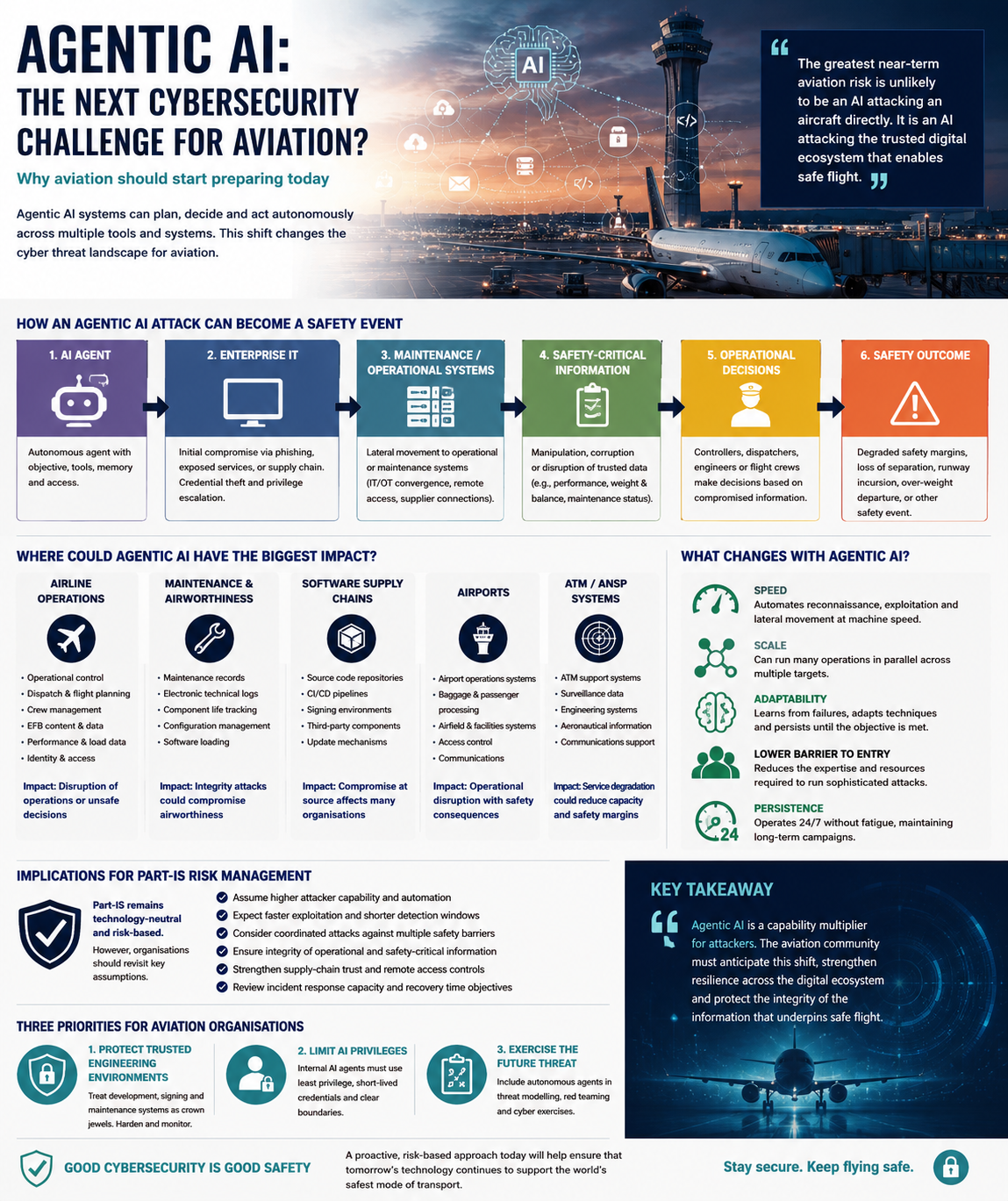
What Changes with Agentic AI?
The key change is speed. Tasks that previously required specialist teams can increasingly be automated and executed continuously.
Agentic AI reduces the effort needed to:
discover vulnerabilities;
adapt exploits;
coordinate multi-stage attacks;
operate at machine speed;
attack multiple targets simultaneously.
This changes attacker economics.
Small teams may soon achieve capabilities previously associated only with highly resourced organisations.
What Does This Mean for Part-IS?
The good news is that Part-IS is already built around a risk-based approach.
Rather than creating entirely new regulatory frameworks, organisations should revisit some of the assumptions underpinning their current risk assessments.
In particular:
attacker capability;
exploitation speed;
supply-chain trust;
integrity of operational information;
resilience of safety barriers;
detection and response times.
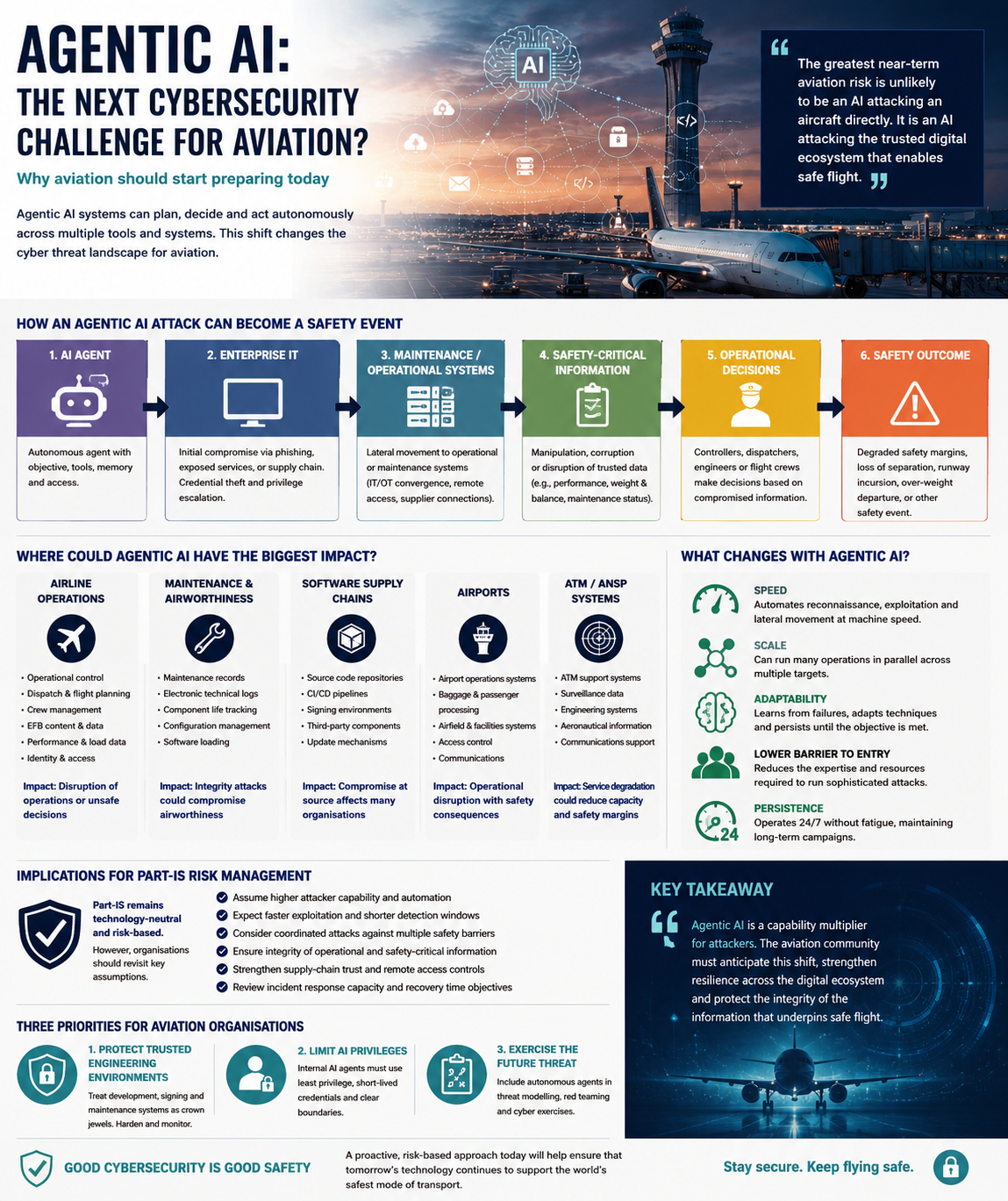
Agentic AI should be viewed primarily as a capability multiplier, not as an entirely new threat category.
Please log in or sign up to comment.