
User account menu

    • EASA Pro
    • EASA Light
    • EASA Community Network
  • User menu
    • Sign up
    • Log in
EASA Community
EASA Community Network
  • Home
  • Air Operations
    • Sections
      • Stream
      • Safety resources
      • Topics
      • Events
      • Members
    • Topics
      • Airport and Ground Handling
      • Maintenance
      • COVID-19
      • ATM
      • Flight Operations
      • Human Factors
  • General Aviation
    • Sections
      • Stream
      • About
      • Safety resources
      • Topics
      • Events
      • Members
    • Topics
      • Sunny Swift
      • Annex 2 Aircraft
      • Balloon Regulation
      • Basic Instrument Rating
      • CS-STAN
      • Declared Training Organisation
      • Generic
      • Glider Regulation
      • Part-21 Proportionality
  • Rotorcraft
    • Sections
      • Stream
      • Safety resources
      • Topics
      • Events
      • Members
    • Topics
      • Other Commercial Ops
      • Offshore Helicopters
      • Non-Commercial (GA) Ops
      • Learning from Accidents
      • Hoist Ops
      • HEMS Ops
  • Cybersecurity
    • Sections
      • Stream
      • Resources hub
      • Topics
      • Events
      • Members
    • Topics
      • All
      • Regulations & Standards
      • Collaboration Initiatives
      • Information Sharing
      • European Strategic Coordination Platform (ESCP)
      • European Centre for Cybersecurity in Aviation (ECCSA)
      • Network of Cybersecurity Analysts (NoCA)
      • Capacity and Competence Building
      • Research & Innovation
      • Vulnerability Disclosure
Skip to Content
  • Home
  • Air Operations
    • Sections
      • Stream
      • Safety resources
      • Topics
      • Events
      • Members
    • Topics
      • Airport and Ground Handling
      • Maintenance
      • COVID-19
      • ATM
      • Flight Operations
      • Human Factors
  • General Aviation
    • Sections
      • Stream
      • About
      • Safety resources
      • Topics
      • Events
      • Members
    • Topics
      • Sunny Swift
      • Annex 2 Aircraft
      • Balloon Regulation
      • Basic Instrument Rating
      • CS-STAN
      • Declared Training Organisation
      • Generic
      • Glider Regulation
      • Part-21 Proportionality
  • Rotorcraft
    • Sections
      • Stream
      • Safety resources
      • Topics
      • Events
      • Members
    • Topics
      • Other Commercial Ops
      • Offshore Helicopters
      • Non-Commercial (GA) Ops
      • Learning from Accidents
      • Hoist Ops
      • HEMS Ops
  • Cybersecurity
    • Sections
      • Stream
      • Resources hub
      • Topics
      • Events
      • Members
    • Topics
      • All
      • Regulations & Standards
      • Collaboration Initiatives
      • Information Sharing
      • European Strategic Coordination Platform (ESCP)
      • European Centre for Cybersecurity in Aviation (ECCSA)
      • Network of Cybersecurity Analysts (NoCA)
      • Capacity and Competence Building
      • Research & Innovation
      • Vulnerability Disclosure
Pablo Dezontini
Pablo Dezontini
5 years ago Public

Takeoff Alternate (TALT) calculations:

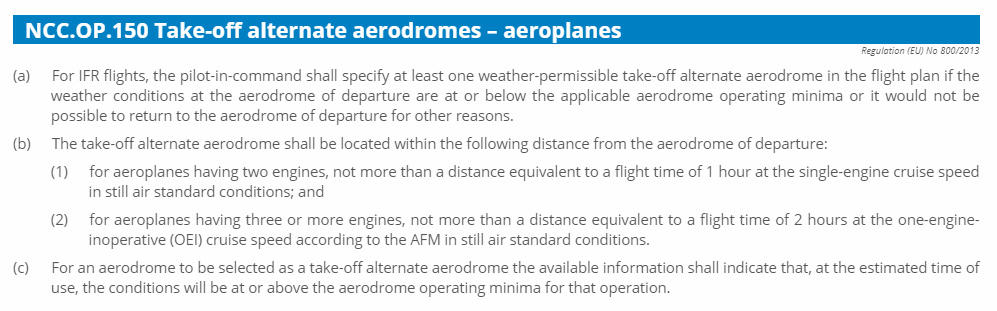
NCC.OP.150 Takeoff Alternate aerodromes - aeroplanes

How Flight Engineering Operations and Dispatcher should calculate this One (01) Hour distance? Consider the One-engine Inoperative (OEI) Climb? Consider the OEI 100ft/min Max ceiling? How about the Thrust Regime (LRC??) Consider the average or real Cruise Temperature (ISA + 15 for example), consider the descent profile? The MTOW or the ATOW? How about Anti-icing Systems, PACKs air flow (Low, High, AUTO), Ice Accretion, etc? Consider cruise wind, etc?

Total amount of likes
3 likes
Dislike 0
Robert Gottwald
Robert Gottwald • 5 years ago

The maximum distance from alternate is determined solely based on One-Engine-Inoperative (OEI) Cruising Speed over time (OEI speed x 2 h = maximum distance). Compare also CAT.OP.MPA.130 for CAT operations and the associated GM1 CAT.OP.MPA.140(c).

Total amount of likes
2 likes
Dislike 0
Stanko Ivan Misetic
Stanko Ivan Misetic • 5 years ago

Dear Pablo,
It specifies the “distance” which is based on the OEI “cruise speed” in “still air” & “standard conditions”. It always remains the same. This is a “fixed” circle distance & will always be the same for alternate airport determination (ie. NOT affected by other performance considerations).
Hope this helps!
Stanko

Total amount of likes
2 likes
Dislike 0
Dominic Waeckerlin
Dominic Waeckerlin • 5 years ago

In our operation we specify a one engine inoperative (threshold distance) (old term but very understandable) in were we incorporate all the factors above. Specifically we define an average profile for the scenario of a take-off alternate (icing, etc.). This profile is aircraft specific and included as a fixed distance in our planning system (Jetplanner). It includes a specific conservatism. I agree with Stankos post above.

Total amount of likes
1 like
Dislike 0
Pablo Dezontini
Pablo Dezontini • 5 years ago

Hi, Guys. It is really interesting how on a small requirement we can find such different or "Alternate Methods of Compliance", don't you think? On Annex ¨6, Parti 1, they state about ISA and Flight Time (not distance), but actually I personally and technically prefer the Dominic approach. To consider the "real" or "expected" scenario and conditions. What do you think, guys?

Total amount of likes
1 like
Dislike 0
Stanko Ivan Misetic
Stanko Ivan Misetic • 5 years ago

Hello Colleagues,

In the end - it may be a question of what your local Authority insists on. The Regulation does not require these adjustments...
Stanko

Total amount of likes
1 like
Dislike 0
Pablo Dezontini
Pablo Dezontini • 5 years ago

Excelente, Mr. Misetic. I fully agree with you. Another interesting point of view is to wonder Why and When this requirement was created. At least from 60’s so far. So, maybe an Operator Best Pratice and a future update of the requirement.

Total amount of likes
0 likes
Dislike 0
Stanko Ivan Misetic
Stanko Ivan Misetic • 5 years ago

I guess it depends on how you look at it: this requirement just defines “how far” an alternate can be - Operators are still required to do precise performance calculations for actually going to the alternate.
Total amount of likes
1 like
Dislike 0

Please log in or sign up to comment.

Footer

  • Data protection
  • Terms and conditions
  • Hosted by EASA
  • Powered by Open Social
  • Support