

Filters
Appendix 5 — Technical specifications related to aircraft observations and reports by voice communications
Regulation (EU) 2024/1111
A.REPORTING INSTRUCTIONS
MODEL AIREP SPECIAL
SECTION | ITEM | PARAMETER | TRANSMIT IN TELEPHONY as appropriate |
– | Message-type designator | [AIREP] SPECIAL | |
─ special air-report | |||
Section 1 | 1 | Aircraft identification | (aircraft identification) |
2 | Position | POSITION (latitude and longitude) | |
OVER (significant point) | |||
ABEAM (significant point) | |||
(significant point) (bearing) (distance) | |||
3 | Time | (time) | |
4 | Level | FLIGHT LEVEL (number) or (number) METERS or FEET | |
CLIMBING TO FLIGHT LEVEL (number) or (number) METERS or FEET | |||
DESCENDING TO FLIGHT LEVEL (number) or (number) METERS or FEET | |||
5 | Next position and estimated time over | (position) (time) | |
6 | Ensuing significant point | (position) NEXT | |
Section 2 | 7 | Estimated time of arrival | (aerodrome) (time) |
8 | Endurance | ENDURANCE (hours and minutes) | |
Section 3 | 9 | Phenomenon encountered or observed prompting a special air-report: | |
─ Moderate turbulence | TURBULENCE MODERATE | ||
─ Severe turbulence | TURBULENCE SEVERE | ||
─ Moderate icing | ICING MODERATE | ||
─ Severe icing | ICING SEVERE | ||
─ Severe mountain wave | MOUNTAIN WAVE SEVERE | ||
─ Thunderstorms without hail | THUNDERSTORMS | ||
─ Thunderstorms with hail | THUNDERSTORMS WITH HAIL | ||
─ Heavy dust/sandstorm | DUSTSTORM or SANDSTORM HEAVY | ||
─ Volcanic ash cloud | VOLCANIC ASH CLOUD | ||
─ Pre- eruption volcanic activity or volcanic eruption | PRE-ERUPTION VOLCANIC ACTIVITY or VOLCANIC ERUPTION | ||
Runway braking action | |||
• Good | GOOD | ||
• Good to medium | GOOD TO MEDIUM | ||
• Medium | MEDIUM | ||
• Medium to poor | MEDIUM TO POOR | ||
• Poor | POOR | ||
• Less than poor | LESS THAN POOR |
1.CONTENTS OF AIR-REPORTS
1.1.Position reports and special air-reports
1.1.1.Section 1 of the model set out in point A is obligatory for position reports and special air-reports, although Items 5 and 6 thereof may be omitted. Section 2 shall be added, in whole or in part, only when so requested by the operator or its designated representative, or when deemed necessary by the pilot-in-command. Section 3 shall be included in special air-reports.
1.1.2.Condition prompting the issuance of a special air-report are to be selected from the list presented in point SERA.12005(a).
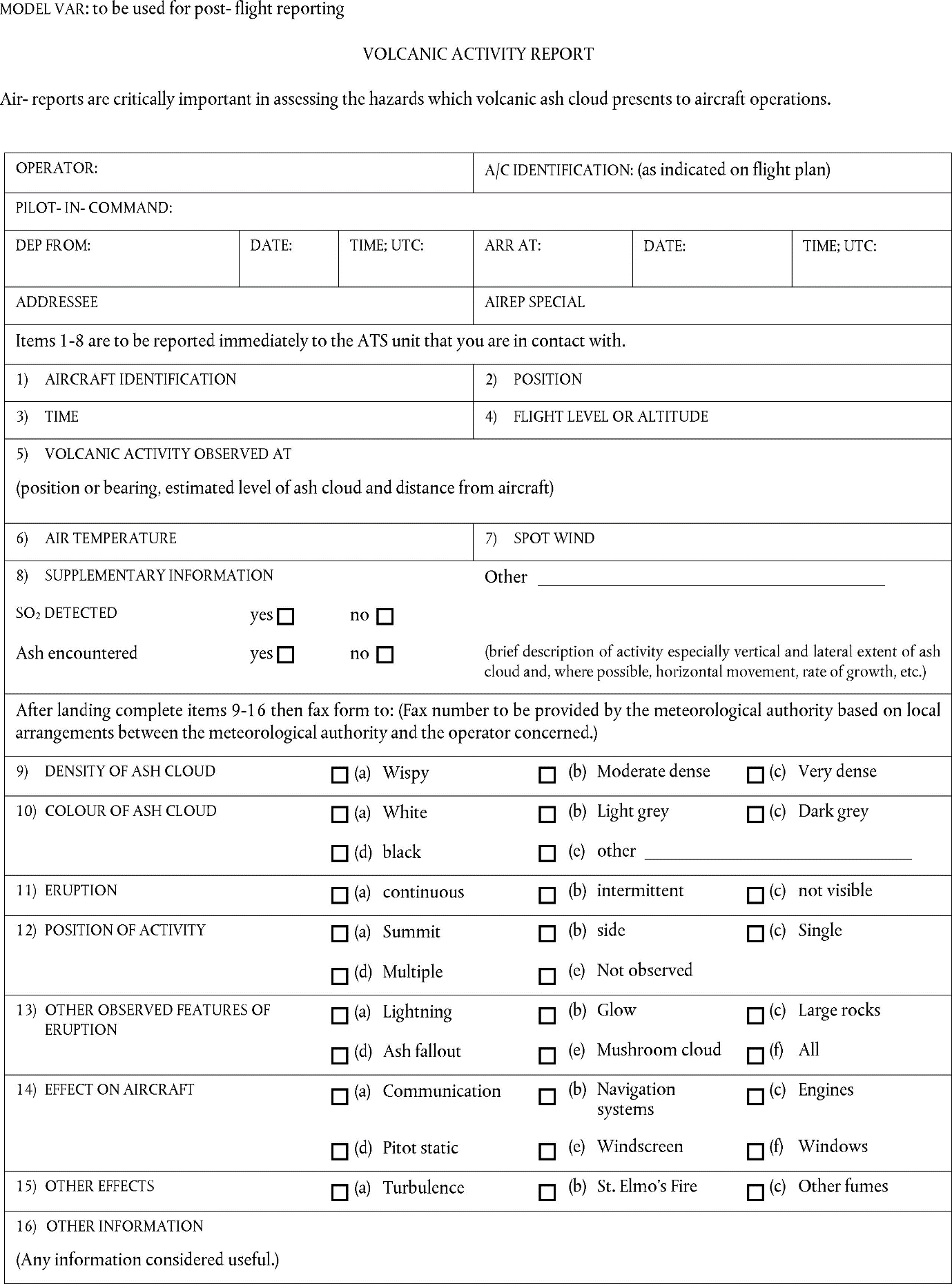
1.1.3.In the case of special air-reports containing information on volcanic activity, a post-flight report shall be made using the volcanic activity reporting form (Model VAR) set out in point B. All elements which are observed shall be recorded and indicated respectively in the appropriate places on the form Model VAR.
1.1.4.Special air-reports shall be issued as soon as practicable after a phenomenon calling for a special air-report has been observed.
2.DETAILED REPORTING INSTRUCTIONS
2.1.Items of an air-report shall be reported in the order in which they are listed in the model AIREP SPECIAL form.
—MESSAGE TYPE DESIGNATOR. Report “SPECIAL” for a special air-report.
Section 1
Item 1 – AIRCRAFT IDENTIFICATION. Report the aircraft radiotelephony call sign as prescribed in point SERA.14050.
Item 2 – POSITION. Report position in latitude (degrees as 2 numerics or degrees and minutes as 4 numerics, followed by “North” or “South”) and longitude (degrees as 3 numerics or degrees and minutes as 5 numerics followed by “East” or “West”), or as a significant point identified by a coded designator (2 to 5 characters), or as a significant point followed by magnetic bearing (3 numerics) and distance in nautical miles from the point. Precede significant point with “ABEAM”, if applicable.
Item 3 – TIME. Report time in hours and minutes UTC (4 numerics) unless reporting time in minutes past the hour (2 numerics) is prescribed on the basis of regional air navigation agreements. The time reported must be the actual time of the aircraft at the position and not the time of origination or transmission of the report. Time shall always be reported in hours and minutes UTC when issuing a special air-report.
Item 4 – FLIGHT LEVEL OR ALTITUDE. Report flight level by 3 numerics when on standard pressure altimeter setting. Report altitude in metres followed by “METRES” or in feet followed by “FEET” when on QNH. Report “CLIMBING” (followed by the level) when climbing or “DESCENDING” (followed by the level) when descending to a new level after passing the significant point.
Item 5 – NEXT POSITION AND ESTIMATED TIME OVER. Report the next reporting point and the estimated time over such reporting point, or report the estimated position that will be reached one hour later, according to the position reporting procedures in force. Use the data conventions specified in Item 2 for position. Report the estimated time over this position. Report time in hours and minutes UTC (4 numerics) unless reporting time in minutes past the hour (2 numerics) as prescribed by regional air navigation agreements.
Item 6 – ENSUING SIGNIFICANT POINT. Report the ensuing significant point following the “next position and estimated time over”.
Section 2
Item 7 – ESTIMATED TIME OF ARRIVAL. Report the name of the aerodrome of the first intended landing, followed by the estimated time of arrival at this aerodrome in hours and minutes UTC (4 numerics).
Item 8 – ENDURANCE. Report “ENDURANCE” followed by fuel/energy endurance in hours and minutes (4 numerics).
Section 3
Item 9 – PHENOMENON PROMPTING A SPECIAL AIR-REPORT. Report one of the following phenomena encountered or observed:
—Moderate turbulence as “TURBULENCE MODERATE”
Severe turbulence as “TURBULENCE SEVERE”
The following specifications apply:
—Moderate – Conditions in which moderate changes in aircraft attitude and/or altitude may occur but the aircraft remains in positive control at all times. Usually, small variations in airspeed. Changes in accelerometer readings of 0,5 g to 1,0 g at the aircraft’s centre of gravity. Difficulty in walking. Occupants feel strain against seat belts. Loose objects move about.
—Severe – Conditions in which abrupt changes in aircraft attitude and/or altitude occur; aircraft may be out of control for short periods. Usually, large variations in airspeed. Changes in accelerometer readings greater than 1,0 g at the aircraft’s centre of gravity. Occupants are forced violently against seat belts. Loose objects are tossed about.
—Moderate icing as “ICING MODERATE”
Severe icing as “ICING SEVERE”
The following specifications apply:
—Moderate – Conditions in which change of heading and/or altitude may be considered desirable.
—Severe – Conditions in which immediate change of heading and/or altitude is considered essential.
—Severe mountain wave as “MOUNTAIN WAVE SEVERE”
The following specification applies:
—Severe – Conditions in which the accompanying downdraft is 3,0 m/s (600 ft/min) or more and/or severe turbulence is encountered.
—Thunderstorm without hail as “THUNDERSTORM”
Thunderstorm with hail as “THUNDERSTORM WITH HAIL”
The following specification applies:
Only report those thunderstorms which are:
—obscured in haze, or
—embedded in cloud, or
—widespread, or
—forming a squall line.
—Heavy duststorm or sandstorm as “DUSTSTORM HEAVY” or “SANDSTORM HEAVY”
—Volcanic ash cloud as “VOLCANIC ASH CLOUD”
—Pre-eruption volcanic activity or a volcanic eruption as “PREERUPTION VOLCANIC ACTIVITY” or “VOLCANIC ERUPTION”
The following specification applies:
“Pre-eruption volcanic activity” in this context means unusual and/or increasing volcanic activity which could presage a volcanic eruption.
—Good braking action as “BRAKING ACTION GOOD”
—Good to medium braking action as “BRAKING ACTION GOOD TO MEDIUM”
—Medium braking action as “BRAKING ACTION MEDIUM”
—Medium to poor braking action as “BRAKING ACTION MEDIUM TO POOR”
—Poor braking action as “BRAKING ACTION POOR”
—Less than poor braking action as “BRAKING ACTION LESS THAN POOR”
The following specifications apply:
Good – Braking deceleration is normal for the wheel braking effort applied, and directional control is normal.
Good to medium – Braking deceleration or directional control is between good and medium.
Medium – Braking deceleration is noticeably reduced for the wheel braking effort applied, or directional control is noticeably reduced.
Medium to poor – Braking deceleration or directional control is between medium and poor.
Poor – Braking deceleration is significantly reduced for the wheel braking effort applied, or directional control is significantly reduced.
Less than poor – Braking deceleration is minimal to non-existent for the wheel braking effort applied, or directional control is uncertain.
2.2Information recorded on the volcanic activity reporting form (Model VAR) is not for transmission by RTF but, on arrival at an aerodrome, is to be delivered without delay by the operator or a flight crew member to the aerodrome meteorological office. If such an office is not easily accessible, the completed form shall be delivered in accordance with local arrangements agreed upon between MET and ATS providers and the aircraft operator.
3.FORWARDING OF METEOROLOGICAL INFORMATION RECEIVED BY VOICE COMMUNICATIONS
When receiving special air-reports, ATS units shall forward these air-reports without delay to the associated meteorological watch office (MWO). In order to ensure assimilation of air-reports in ground-based automated systems, the elements of such reports shall be transmitted using the data conventions specified below and in the order prescribed.
—ADDRESSEE. Record the station called and, when necessary, relay required.
—MESSAGE TYPE DESIGNATOR. Record “ARS” for a special air-report.
—AIRCRAFT IDENTIFICATION. Record the aircraft identification using the data convention specified for Item 7 of the flight plan, without a space between the operator’s designator and the aircraft registration or flight identification, if used.
Section 1
Item 0 – POSITION. Record position in latitude (degrees as 2 numerics or degrees and minutes as 4 numerics, followed, without a space, by N or S) and longitude (degrees as 3 numerics or degrees and minutes as 5 numerics, followed without a space by E or W), or as a significant point identified by a coded designator (2 to 5 characters), or as a significant point followed by magnetic bearing (3 numerics) and distance in nautical miles (3 numerics) from the point. Precede significant point with “ABEAM”, if applicable.
Item 1 – TIME. Record time in hours and minutes UTC (4 numerics).
Item 2 – FLIGHT LEVEL OR ALTITUDE. Record “F” followed by 3 numerics (e.g. “F310”) when a flight level is reported. Record altitude in metres followed by “M” or in feet followed by “FT” when an altitude is reported. Record “ASC” (level) when climbing or “DES” (level) when descending.
Section 3
Item 9 – PHENOMENON PROMPTING A SPECIAL AIR-REPORT. Record the phenomenon reported as follows:
—moderate turbulence as “TURB MOD”,
—severe turbulence as “TURB SEV”,
—moderate icing as “ICE MOD”,
—severe icing as “ICE SEV”,
—severe mountain wave as “MTW SEV”,
—thunderstorm without hail as “TS”,
—thunderstorm with hail as “TSGR”,
—heavy sandstorm as “HVY SS”,
—heavy duststorm as “HVY DS”,
—volcanic ash cloud as “VA CLD”,
—pre-eruption volcanic activity or a volcanic eruption as “VA”,
—hail as “GR”,
—cumulonimbus clouds as “CB”.
TIME TRANSMITTED. Record only when Section 3 is transmitted.
4.SPECIFIC PROVISIONS RELATED TO REPORTING WIND SHEAR AND VOLCANIC ASH
4.1.Reporting of wind shear
4.1.1.When reporting aircraft observations of wind shear encountered during the climb-out and approach phases of flight, the aircraft type shall be included.
4.1.2.Where wind shear conditions in the climb-out or approach phases of flight were reported or forecast but not encountered, the pilot-in-command shall advise the appropriate air traffic services unit as soon as practicable unless the pilot-in-command is aware that the appropriate air traffic services unit has already been so advised by a preceding aircraft.
4.2.Post-flight reporting of volcanic activity
4.2.1.On arrival of a flight at an aerodrome, the completed report of volcanic activity shall be delivered by the aircraft operator or a flight crew member, without delay, to the aerodrome meteorological office, or if such office is not easily accessible to arriving flight crew members, the completed form shall be dealt with in accordance with local arrangements agreed upon between MET and ATS providers and the aircraft operator.
4.2.2.The completed report of volcanic activity received by an aerodrome meteorological office shall be transmitted without delay to the meteorological watch office responsible for the provision of meteorological watch for the flight information region in which the volcanic activity was observed.
B.SPECIAL AIR-REPORT OF VOLCANIC ACTIVITY FORM (MODEL VAR)
GM1 to Appendix 5 (2 — Section 1) DETAILED REPORTING INSTRUCTIONS
ED Decision 2016/023/R
POSITION
Example:
‘4620North07805West’, ‘4620North07800West’, ‘4600North07800West’, LN (‘LIMA NOVEMBER’), ‘MAY’, ‘HADDY’ or ‘DUB 180 DEGREES 40 MILES’
GM1 to Appendix 5 (2 — Section 1) DETAILED REPORTING INSTRUCTIONS
ED Decision 2016/023/R
FLIGHT LEVEL OR ALTITUDE
Example:
‘FLIGHT LEVEL 310’
GM1 to Appendix 5 (2 — Section 3) DETAILED REPORTING INSTRUCTIONS
ED Decision 2016/023/R
PHENOMENON PROMPTING A SPECIAL AIR-REPORT - VOLCANIC ASH CLOUD, PRE-ERUPTION VOLCANIC ACTIVITY, OR VOLCANIC ERUPTION
In case of volcanic ash cloud, pre-eruption volcanic activity, or volcanic eruption, in accordance with SERA.12005, a post-flight report should also be made on the special air-report of volcanic activity form (Model VAR).
GM1 to Appendix 5 (3) FORWARDING OF METEOROLOGICAL INFORMATION RECEIVED BY VOICE COMMUNICATIONS
ED Decision 2016/023/R
AIRCRAFT IDENTIFICATION
Example:
‘New Zealand 103’ as ‘ANZ103’
GM1 to Appendix 5 (3 — Section 1) FORWARDING OF METEOROLOGICAL INFORMATION RECEIVED BY VOICE COMMUNICATIONS
ED Decision 2016/023/R
POSITION
Example:
‘4620N07805W’, ‘4620N078W’, ‘46N078W’, ‘LN’, ‘MAY’, ‘HADDY’ or ‘DUB180040’.
GM1 to Appendix 5 (1.1.4 and 2.1) SPECIAL AIR-REPORTS
ED Decision 2016/023/R
Examples of special air reports by voice communication
AS SPOKEN IN RADIOTELEPHONY | AS RECORDED BY THE AIR TRAFFIC SERVICES UNIT AND FORWARDED TO THE METEOROLOGICAL OFFICE CONCERNED |
I.-35 AIREP SPECIAL CLIPPER WUN ZERO WUN POSITION FIFE ZERO FOWer FIFE NORTH ZERO TOO ZERO WUN FIFE WEST WUN FIFE TREE SIX FLIGHT LEVEL TREE WUN ZERO CLIMBING TO FLIGHT LEVEL TREE FIFE ZERO THUNDERSTORMS WITH HAIL | I.- ARS PAA101 5045N02015W 1536 F310 ASC F350 TSGR |
II.-36 SPECIAL NIUGINI TOO SEVen TREE OVER MADANG ZERO AIT FOWer SIX WUN NINer TOUSAND FEET TURBULENCE SEVERE | II.- ARS ANG273 MD 0846 19000FT TURB SEV |
Appendix 6 — Completion of a flight plan
Regulation (EU) 2024/404
1.ICAO MODEL FLIGHT PLAN FORM
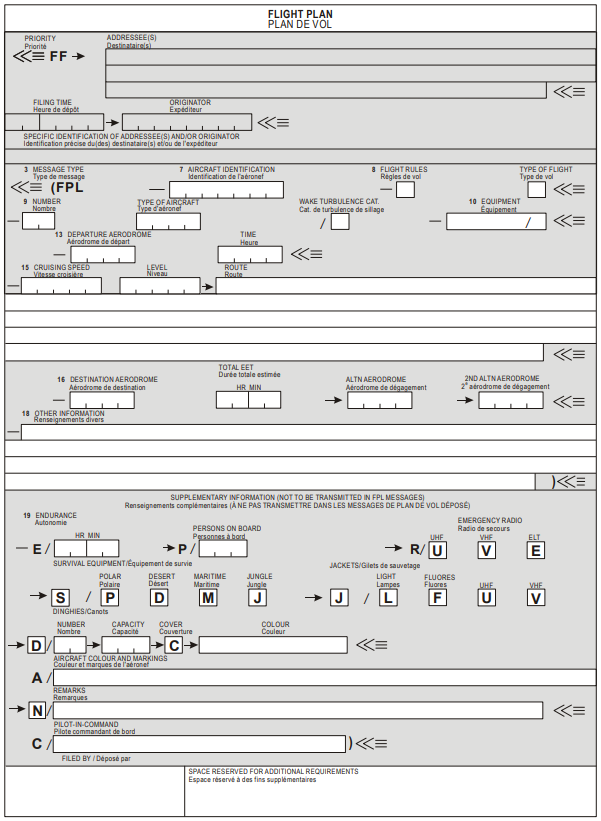
2.INSTRUCTIONS FOR THE COMPLETION OF THE FLIGHT PLAN FORM
2.1General
Adhere closely to the prescribed formats and manner of specifying data.
Commence inserting data in the first space provided. Where excess space is available, leave unused spaces blank.
Insert all clock times in 4 figures UTC.
Insert all estimated elapsed times in 4 figures (hours and minutes).
The shaded area preceding item 3 – shall be completed by ATS and COM services, unless the responsibility for originating flight plan messages has been delegated.
2.2Instructions for insertion of ATS data
Complete items 7 to 18 and, when so required by the competent authority or otherwise deemed necessary, item 19 as indicated hereunder.

INSERT one of the following aircraft identifications, not exceeding 7 alphanumeric characters and without hyphens or symbols:
(a)the ICAO designator for the aircraft operator followed by the flight identification (e.g. KLM511, NGA213, JTR25) when in radiotelephony the call sign to be used by the aircraft consists of the ICAO telephony designator for the operator followed by the flight identification (e.g. KLM511, NIGERIA 213, JESTER 25); or
(b)the nationality or common mark and registration mark of the aircraft (e.g. EIAKO, 4XBCD, N2567GA), when:
(1)in radiotelephony the call sign to be used by the aircraft consists of this identification alone (e.g. CGAJS), or preceded by the ICAO telephony designator for the aircraft operator (e.g. BLIZZARD CGAJS);
(2)the aircraft is not equipped with radio.
INSERT one of the following letters to denote the category of flight rules with which the pilot intends to comply:
I –if it is intended that the entire flight is operated under IFR; or
V –if it is intended that the entire flight is operated under VFR; or
Y –if the flight is initially operated under IFR, followed by one or more subsequent changes of flight rules; or
Z –if the flight is initially operated under VFR, followed by one or more subsequent changes of flight rules.
Specify in Item 15 the point or points at which a change of flight rules is planned.
INSERT one of the following letters to denote the type of flight when so required by the competent authority:
S –if scheduled air service;
N –if non-scheduled air transport operation;
G –if general aviation;
M –if military;
X –if other than any of the defined categories above.
Specify status of a flight following the indicator STS in Item 18, or when necessary to denote other reasons for specific handling by ATS, indicate the reason following the indicator RMK in Item 18.
INSERT the number of aircraft, if more than one.

INSERTthe appropriate designator as specified in Doc 8643, Aircraft Type Designators,
OR,if no such designator has been assigned, or in case of formation flights comprising more than one type,
INSERTZZZZ, and SPECIFY in item 18 the (numbers and) type(s) of aircraft preceded by ‘TYP/ .

INSERT an oblique stroke followed by one of the following letters to indicate the wake turbulence category of the aircraft:
J –SUPER, to indicate an aircraft type specified as such in ICAO Doc 8643, Aircraft Type Designators, latest edition;
H –HEAVY, to indicate an aircraft type with a maximum certified take-off mass of 136 000 kg or more, with the exception of aircraft types listed in ICAO Doc 8643 in the SUPER (J) category;
M –MEDIUM, to indicate an aircraft type with a maximum certified take-off mass of less than 136 000 kg but more than 7 000 kg;
L –LIGHT, to indicate an aircraft type with a maximum certified take-off mass of 7 000 kg or less.

Capabilities comprise the following elements:
(a)presence of relevant serviceable equipment on board the aircraft;
(b)equipment and capabilities commensurate with flight crew qualifications; and
(c)where applicable, authorisation from the appropriate authority.
INSERT one letter as follows:
N –if no COM/NAV/approach aid equipment for the route to be flown is carried, or the equipment is unserviceable;
OR
S –if standard COM/NAV/approach aid equipment for the route to be flown is carried and serviceable;
AND/OR
INSERT one or more of the following letters to indicate the serviceable COM/NAV/approach aid equipment and capabilities available:
AGBAS landing system
BLPV (APV with SBAS)
CLORAN C
DDME
E1FMC WPR ACARS
E2D-FIS ACARS
E3PDC ACARS
FADF
GGNSS. If any portion of the flight is planned to be conducted under IFR, it refers to GNSS receivers that comply with the requirements of Annex 10, Volume I
HHF RTF
IInertial Navigation
J1CPDLC ATN VDL Mode 2
J2CPDLC FANS 1/A HFDL
J3CPDLC FANS 1/A VDL Mode A
J4CPDLC FANS 1/A VDL Mode 2
J5CPDLC FANS 1/A SATCOM (INMARSAT)J6CPDLC FANS 1/A SATCOM (MTSAT)
J7CPDLC FANS 1/A SATCOM (Iridium)
KMLS
LILS
M1ATC SATVOICE (INMARSAT)
M2ATC SATVOICE (MTSAT)
M3ATC SATVOICE (Iridium)
OVOR
P1CPDLC RCP 400
P2CPDLC RCP 240
P3SATVOICE RCP 400
P4-P9Reserved for RCP
RPBN approved
TTACAN
UUHF RTF
VVHF RTF
WRVSM approved
XMNPS approved
YVHF with 8.33 kHz channel spacing capability
ZOther equipment carried or other capabilities
Any alphanumeric characters not indicated above are reserved.

INSERTN if no surveillance equipment for the route to be flown is carried, or the equipment is unserviceable;
OR
INSERTone or more of the following descriptors, to a maximum of 20 characters, to describe the serviceable surveillance equipment and/or capabilities on board:
SSR Modes A and C
A –Transponder – Mode A (4 digits – 4 096 codes)
C –Transponder – Mode A (4 digits – 4 096 codes) and Mode C
SSR Mode S
E –Transponder – Mode S, including aircraft identification, pressure-altitude and extended squitter (ADS-B) capability
H –Transponder – Mode S, including aircraft identification, pressure-altitude and enhanced surveillance capability
I –Transponder – Mode S, including aircraft identification, but no pressure-altitude capability
L –Transponder – Mode S, including aircraft identification, pressure-altitude, extended squitter (ADS-B) and enhanced surveillance capability
P –Transponder – Mode S, including pressure-altitude, but no aircraft identification capability
S –Transponder – Mode S, including both pressure-altitude and aircraft identification capability
X –Transponder – Mode S with neither aircraft identification nor pressure-altitude capability
ADS-B
B1 –ADS-B with dedicated 1 090 MHz ADS-B “out” capability
B2 –ADS-B with dedicated 1 090 MHz ADS-B “out” and “in” capability
U1 –ADS-B “out” capability using UAT
U2 –ADS-B “out” and “in” capability using UAT
V1 –ADS-B “out” capability using VDL Mode 4
V2 –ADS-B “out” and “in” capability using VDL Mode 4
ADS-C
D1 –ADS-C with FANS 1/A capabilities
G1 –ADS-C with ATN capabilities
Alphanumeric characters not indicated above are reserved.

INSERTthe ICAO 4-letter location indicator of the departure aerodrome as specified in Doc 7910, Location Indicators;
OR,if no location indicator has been assigned,
INSERTZZZZ and SPECIFY, in Item 18:
—the name and location of the aerodrome preceded by DEP/; or
—the first point of the route or the marker radio beacon preceded by DEP/…, if the aircraft has not taken off from an aerodrome;
OR, –if the flight plan is received from an aircraft in flight,
INSERTAFIL, and SPECIFY, in Item 18, the ICAO 4-letter location indicator of the location of the ATS unit from which supplementary flight plan data can be obtained, preceded by DEP/.
THEN, WITHOUT A SPACE,
INSERTfor a flight plan submitted before departure, the estimated off-block time (EOBT),
OR,for a flight plan received from an aircraft in flight, the actual or estimated time over the first point of the route to which the flight plan applies.

INSERTthe first cruising speed as in (a) and the first cruising level as in (b), without a space between them.
THEN,following the arrow, INSERT the route description as in (c).

INSERTthe True airspeed for the first or the whole cruising portion of the flight, in terms of:
Kilometres per hour, expressed as K followed by 4 figures (e.g. K0830), or
Knots, expressed as N followed by 4 figures (e.g. N0485), or
True Mach number, when so prescribed by the appropriate ATS authority, to the nearest hundredth of unit Mach, expressed as M followed by 3 figures (e.g. M082).

INSERTthe planned cruising level for the first or the whole portion of the route to be flown, in terms of:
Flight level, expressed as F followed by 3 figures (e.g. F085; F330), or
Standard metric level in tens of metres, when so prescribed by the competent authority expressed as S followed by 4 figures (e.g. S1130), or
Altitude in hundreds of feet, expressed as A followed by 3 figures (e.g. A045; A100), or
Altitude in tens of metres, expressed as M followed by 4 figures (e.g. M0840), or
for uncontrolled VFR flights, the letters VFR.

Flights along designated ATS routes
INSERT,if the departure aerodrome is located on or connected to the ATS route, the designator of the first ATS route,
OR,if the departure aerodrome is not on or connected to the ATS route, the letters DCT followed by the point of joining the first ATS route, followed by the designator of the ATS route.
THEN
INSERTeach point at which either a change of speed and/or level is planned to commence, or a change of ATS route, and/or a change of flight rules is planned,
FOLLOWED IN EACH CASE
by the designator of the next ATS route segment, even if it is the same as the previous one,
ORby DCT, if the flight to the next point is outside a designated route, unless both points are defined by geographical coordinates.
Flights outside designated ATS routes
INSERTpoints normally not more than 30 minutes flying time or 370 km (200 NM) apart, including each point at which a change of speed or level, a change of track, or a change of flight rules is planned,
OR,when required by competent authority(ies),
DEFINEthe track of flights operating predominantly in an east-west direction between 70°N and 70°S by reference to significant points formed by the intersections of half or whole degrees of latitude with meridians spaced at intervals of 10 degrees of longitude. For flights operating in areas outside those latitudes, the tracks shall be defined by significant points formed by the intersection of parallels of latitude with meridians normally spaced at 20 degrees of longitude. The distance between significant points shall, as far as possible, not exceed 1 hour’s flight time. Additional significant points shall be established as deemed necessary.
For flights operating predominantly in a north-south direction, define tracks by reference to significant points formed by the intersection of whole degrees of longitude with specified parallels of latitude which are spaced at 5 degrees.
INSERTDCT between successive points unless both points are defined by geographical coordinates or by bearing and distance.
USE ONLY the conventions in (1) to (5) below and SEPARATE each sub-item by a space.
(1)

The coded designator assigned to the route or route segment including, where appropriate, the coded designator assigned to the standard departure or arrival route (e.g. BCN1, Bl, R14, UB10, KODAP2A).
(2)

The coded designator (2 to 5 characters) assigned to the point (e.g. LN, MAY, HADDY),
or, if no coded designator has been assigned, one of the following ways:
—Degrees only (7 characters):
2 figures describing latitude in degrees, followed by “N” (North) or “S” (South), followed by 3 figures describing longitude in degrees, followed by “E” (East) or “W” (West). Make up the correct number of figures, where necessary, by insertion of zeros, e.g. 46N078W.
—Degrees and minutes (11 characters):
4 figures describing latitude in degrees and tens and units of minutes followed by “N” (North) or “S” (South), followed by 5 figures describing longitude in degrees and tens and units of minutes, followed by “E” (East) or “W” (West). Make up the correct number of figures, where necessary, by insertion of zeros, e.g. 4620N07805W.
—Bearing and distance from a reference point:
The identification of the reference point, followed by the bearing from the point in the form of 3 figures giving degrees magnetic, followed by the distance from the point in the form of 3 figures expressing nautical miles. In areas of high latitude where it is determined by the appropriate authority that reference to degrees magnetic is impractical, degrees true may be used. Make up the correct number of figures, where necessary, by insertion of zeros – e.g. a point 180° magnetic at a distance of 40 NM from VOR “DUB” should be expressed as DUB180040.
(3)

The point at which a change of speed (5 % TAS or 0,01 Mach or more) or a change of level is planned to commence, expressed exactly as in (2) above, followed by an oblique stroke and both the cruising speed and the cruising level, expressed exactly as in (a) and (b) above, without a space between them, even when only one of these quantities will be changed.
Examples:LN/N0284A045
MAY/N0305Fl80
HADDY/N0420F330
4602N07805W/N0500F350
46N078W/M082F330
DUB180040/N0350M0840
(4)

The point at which the change of flight rules is planned, expressed exactly as in (2) or (3) above as appropriate, followed by a space and one of the following:
VFR if from IFR to VFR
IFR if from VFR to IFR
Examples:LN VFR
LN/N0284A050 IFR
(5)

The letter C followed by an oblique stroke; THEN the point at which cruise climb is planned to start, expressed exactly as in (2) above, followed by an oblique stroke; THEN the speed to be maintained during cruise climb, expressed exactly as in (a) above, followed by the two levels defining the layer to be occupied during cruise climb, each level expressed exactly as in (b) above, or the level above which cruise climb is planned followed by the letters PLUS, without a space between them.
Examples:C/48N050W/M082F290F350
C/48N050W/M082F290PLUS
C/52N050W/M220F580F620
INSERTthe ICAO 4-letter location indicator of the destination aerodrome as specified in Doc 7910, Location Indicators,
OR,if no location indicator has been assigned,
INSERTZZZZ and SPECIFY in Item 18 the name and location of the aerodrome, preceded by DEST/.
THEN WITHOUT A SPACE
INSERTthe total estimated elapsed time.

INSERTthe ICAO 4-letter location indicator(s) of not more than two destination alternate aerodromes, as specified in Doc 7910, Location Indicators, separated by a space,
OR,if no location indicator has been assigned to the destination alternate aerodrome(s),
INSERTZZZZ and SPECIFY in Item 18 the name and location of the destination alternate aerodrome(s), preceded by ALTN/.

Hyphens or oblique strokes should only be used as prescribed below.
INSERT0 (zero) if no other information,
OR,any other necessary information in the sequence shown hereunder, in the form of the appropriate indicator selected from those defined hereunder followed by an oblique stroke and the information to be recorded:
STS/Reason for special handling by ATS, e.g. a search and rescue mission, as follows:
ALTRV:for a flight operated in accordance with an altitude reservation;
ATFMX:for a flight approved for exemption from ATFM measures by the competent authority;
FFR:firefighting;
FLTCK:flight check for calibration of navaids;
HAZMAT:for a flight carrying hazardous material;
HEAD:a flight with Head of State status;
HOSP:for a medical flight declared by medical authorities;
HUM:for a flight operating on a humanitarian mission
MARSA:for a flight for which a military entity assumes responsibility for separation of military aircraft;
MEDEVAC:for a life-critical medical emergency evacuation;
NONRVSM:for a non-RVSM-capable flight intending to operate in RVSM airspace;
SAR:for a flight engaged in a search and rescue mission; and
STATE:for a flight engaged in military, customs, or police services.
Other reasons for special handling by ATS shall be denoted under the designator “RMK/”.
PBN/Indication of RNAV and/or RNP capabilities. Include as many of the descriptors below, as apply to the flight, up to a maximum of 8 entries, i.e. a total of not more than 16 characters.
RNAV SPECIFICATIONS
A1RNAV 10 (RNP 10)
B1RNAV 5 all permitted sensors
B2RNAV 5 GNSS
B3RNAV 5 DME/DME
B4RNAV 5 VOR/DME
B5RNAV 5 INS or IRS
B6RNAV 5 LORANC
C1RNAV 2 all permitted sensors
C2RNAV 2 GNSS
C3RNAV 2 DME/DME
C4RNAV 2 DME/DME/IRU
D1RNAV 1 all permitted sensors
D2RNAV 1 GNSS
D3RNAV 1 DME/DME
D4RNAV 1 DME/DME/IRU
RNP SPECIFICATIONS
L1RNP 4
O1Basic RNP 1 all permitted sensors
O2Basic RNP 1 GNSS
O3Basic RNP 1 DME/DME
O4Basic RNP 1 DME/DME/IRU
S1RNP APCH
S2RNP APCH with BARO-VNAV
T1RNP AR APCH with RF (special authorization required)
T2RNP AR APCH without RF (special authorization required)
Combinations of alphanumeric characters not indicated above are reserved.
NAV/Significant data related to navigation equipment, other than specified in PBN/, as required by the competent authority.
Indicate GNSS augmentation under this indicator, with a space between two or more methods of augmentation, e.g. NAV/GBAS SBAS.
Indicate EURPRNAV if the aircraft approved P-RNAV relies solely on VOR/DME for the determination of position.
COM/Indicate communication equipment and capabilities not specified in Item 10 a).
DAT/Indicate data communication equipment and capabilities not specified in Item 10 a) or “CPDLCX” to indicate exemption granted from the requirement to be equipped with CPDLC-ATN-B1.
SUR/Indicate surveillance equipment and capabilities not specified in Item 10 b). Indicate as many RSP specification(s) as apply to the flight, using designator(s) with no space. Multiple RSP specifications are separated by a space. Example: RSP180 RSP400.
Insert EUADSBX, EUEHSX, EUELSX, or a combination of them, to indicate exemptions granted for the requirement to be equipped with SSR Mode S transponders or ADS-B transmitters.
DEP/Name and location of departure aerodrome, if ZZZZ is inserted in Item 13, or the ATS unit from which supplementary flight plan data can be obtained, if AFIL is inserted in Item 13. For aerodromes not listed in the relevant Aeronautical Information Publication, indicate location as follows:
With 4 figures describing latitude in degrees and tens and units of minutes followed by “N” (North) or “S” (South), followed by 5 figures describing longitude in degrees and tens and units of minutes, followed by “E” (East) or “W” (West). Make up the correct number of figures, where necessary, by insertion of zeros, e.g. 4620N07805W (11 characters).
OR,Bearing and distance from the nearest significant point, as follows:
The identification of the significant point followed by the bearing from the point in the form of 3 figures giving degrees magnetic, followed by the distance from the point in the form of 3 figures expressing NM. In areas of high latitude where it is determined by the appropriate authority that reference to degrees magnetic is impractical, degrees true may be used. Make up the correct number of figures, where necessary, by insertion of zeros, e.g. a point of 180° magnetic at a distance of 40 NM from VOR “DUB” should be expressed as DUB180040.
OR,The first point of the route (name or LAT/LONG) or the marker radio beacon, if the aircraft has not taken off from an aerodrome.
DEST/Name and location of destination aerodrome, if ZZZZ is inserted in Item 16. For aerodromes not listed in the relevant Aeronautical Information Publication, indicate location in LAT/LONG or bearing and distance from the nearest significant point, as described under DEP/above.
DOF/The date of flight departure in a 6-figure format (YYMMDD, where YY equals the year, MM equals the month, and DD equals the day).
REG/The nationality or common mark and registration mark of the aircraft, if different from the aircraft identification in Item 7.
EET/Significant points or FIR boundary designators and accumulated estimated elapsed times from take-off to such points or FIR boundaries, when so prescribed on the basis of regional air navigation agreements, or by the competent authority.
Examples:EET/CAP0745 XYZ0830
EET/EINN0204
SEL/SELCAL Code, for aircraft so equipped.
TYP/Type(s) of aircraft, preceded if necessary without a space by number(s) of aircraft and separated by one space, if ZZZZ is inserted in Item 9.
Example:TYP/2F15 5F5 3B2
CODE/Aircraft address (expressed in the form of an alphanumerical code of 6 hexadecimal characters) when required by the competent authority. Example: “F00001” is the lowest aircraft address contained in the specific block administered by ICAO.
DLE/En-route delay or holding, insert the significant point(s) on the route where a delay is planned to occur, followed by the length of delay using 4-figure time in hours and minutes (hhmm).
Example: DLE/MDG0030
OPR/ICAO designator or name of the aircraft operator, if different from the aircraft identification in Item 7.
ORGN/The originator’s 8-letter AFTN address or other appropriate contact details, in cases where the originator of the flight plan may not be readily identified, as required by the competent authority.
PER/Aircraft performance data, indicated by a single letter as specified in the Procedures for Air Navigation Services – Aircraft Operations (PANS-OPS, Doc 8168), Volume I – Flight Procedures, if so prescribed by the competent authority.
ALTN/Name of destination alternate aerodrome(s), if ZZZZ is inserted in Item 16. For aerodromes not listed in the relevant Aeronautical Information Publication, indicate location in LAT/LONG or bearing and distance from the nearest significant point, as described in DEP/above.
RALT/ICAO 4-letter indicator(s) for en-route alternate(s), as specified in Doc 7910, Location Indicators, or name(s) of en-route alternate aerodrome(s), if no indicator is allocated. For aerodromes not listed in the relevant Aeronautical Information Publication, indicate location in LAT/LONG or bearing and distance from the nearest significant point, as described in DEP/above.
TALT/ICAO 4-letter indicator(s) for take-off alternate, as specified in Doc 7910, Location Indicators, or name of take-off alternate aerodrome, if no indicator is allocated. For aerodromes not listed in the relevant Aeronautical Information Publication, indicate location in LAT/LONG or bearing and distance from the nearest significant point, as described in DEP/above.
RIF/The route details to the revised destination aerodrome, followed by the ICAO 4-letter location indicator of the aerodrome. The revised route is subject to reclearance in flight.
Examples:RIF/DTA HEC KLAX
RIF/ESP G94 CLA YPPH
RVR/minimum runway visual range requirement for the flight expressed in 3 figures.
RFP/indication of the number of the replacement flight plans submitted in format “Q” followed by 1 figure indicating the iteration of replacement.
Examples:RFP/Q2.
RMK/Any other plain-language remarks when required by the competent authority or deemed necessary.
After E/INSERT a 4-figure group giving the fuel endurance in hours and minutes.
After P/INSERT the total number of persons (passengers and crew) on board, when required by the competent authority. INSERT TBN (to be notified) if the total number of persons is not known at the time of filing.

R/(RADIO)CROSS OUT U if UHF on frequency 243,0 MHz is not available.
CROSS OUT V if VHF on frequency 121,5 MHz is not available.
CROSS OUT E if emergency locator transmitter (ELT) is not available.
S/(SURVIVAL EQUIPMENT)CROSS OUT all indicators if survival equipment is not carried.
CROSS OUT P if polar survival equipment is not carried.
CROSS OUT D if desert survival equipment is not carried.
CROSS OUT M if maritime survival equipment is not carried.
CROSS OUT J if jungle survival equipment is not carried.
J/(JACKETS)CROSS OUT all indicators if life jackets are not carried.
CROSS OUT L if life jackets are not equipped with lights.
CROSS OUT F if life jackets are not equipped with fluorescein.
CROSS OUT U or V or both as in R/above to indicate radio capability of jackets, if any.
D/(DINGHIES)CROSS OUT indicators D and C if no dinghies are carried; or
(NUMBER)INSERT number of dinghies carried; and
(CAPACITY) – INSERT total capacity, in persons, of all dinghies carried; and
(COVER) – CROSS OUT indicator C if dinghies are not covered; and
(COLOUR) – INSERT colour of dinghies if carried.
A/(AIRCRAFT COLOURINSERT colour of aircraft and significant markings.
AND MARKINGS)
N/(REMARKS)CROSS OUT indicator N if no remarks, or INDICATE any other survival equipment carried and any other remarks regarding survival equipment.
C/(PILOT)INSERT name of pilot-in-command.
2.3Filed by
INSERTthe name of the unit, the agency or the person filing the flight plan.
Supplement to the ANNEX
Supplement to the ANNEX
Regulation (EU) 2024/404
[Deleted.]