

Filters
Appendix 1 to AMC1 SERA.6005(c) Requirements for communications, SSR transponder and electronic conspicuity in U-space airspace
ED Decision 2022/024/R
ADS-L MESSAGE GENERATION FUNCTION
(a)This AMC details the minimum set of parameters that should be transmitted, and a set of parameters that may be optionally transmitted.
(b)All parameters should originate from a position source or from the system configuration. Each ADS-L message should include an identifier unique to the transmission source.
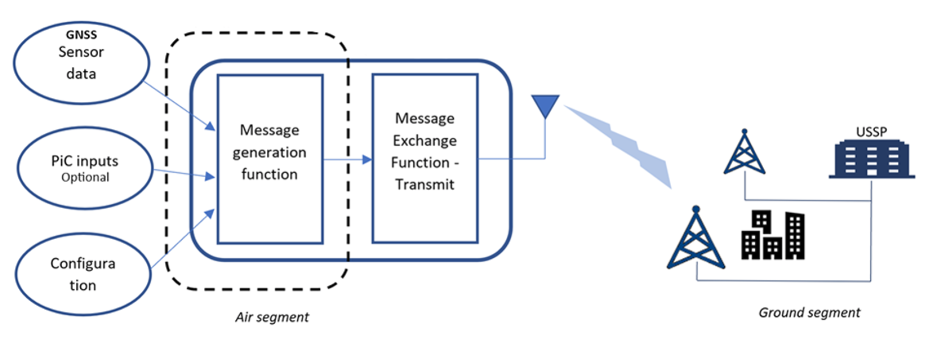
Figure 1: The scope of the ADS-L message generation function (dashed line) as specified
in Appendix 1 to AMC1 to SERA.6005(c)
TRANSMITTED PARAMETERS
Data type | Parameter | Required/optional | Remarks | Source |
Aircraft address | Unique identifier / address | Required | Should be included in each transmission | Configuration |
Address type | Required | See the table below | Configuration | |
Time | Timestamp | Required | Position source | |
Aircraft identification | Aircraft category | Required | See the table below | Configuration |
Emergency status | Emergency status | Optional | See the table below | Pilot-in-command inputs |
Position | Latitude | Required | Reference WGS-84 | Position source |
Longitude | Required | Reference WGS-84 | Position source | |
GNSS altitude | Required | Reference WGS-84 | Position source | |
Velocity/track | Ground speed | Required | Alternatively, north-south, east-west velocities | Position source |
Ground track | Required | Position source | ||
Vertical rate | Required | Position source | ||
Velocity accuracy | Optional | See the table below | Position source | |
Capabilities and status | Version | Required | To facilitate interoperability | Configuration |
Design assurance | Optional | See the table below | Configuration | |
Horizontal position accuracy | Required | 95 % confidence | Position source | |
Vertical position accuracy | Required | 95 % confidence | Position source | |
Navigation integrity | Optional | Containment radius (Rc) | Position source | |
Source integrity level | Optional | Probability that Rc is exceeded | Configuration |
TABLES FOR REQUIRED PARAMETERS
Data type | Values |
Address type | Reserved |
ICAO | |
Unique identifier | |
Reserved |
Parameter | Values |
Aircraft category | No emitter category information available |
Light fixed-wing (<7 031 kg / 15 500 lb) | |
Small to heavy fixed-wing (≥7 031 kg / 15 500 lb) | |
Light rotorcraft | |
Heavy rotorcraft | |
Glider/sailplane | |
Lighter-than-air | |
Ultralight | |
Hang-glider | |
Paraglider | |
Parachutist/skydiver/wingsuit | |
eVTOL/UAM | |
UAS ‘open’ category | |
UAS ‘specific’ category | |
UAS ‘certified’ category | |
Model plane | |
Reserved |
Parameter | 95 % horizontal accuracy bound |
EPU ≥ 926 m (0.5 NM) | |
EPU < 926 m (0.5 NM) | |
EPU < 555.6 m (0.3 NM) | |
EPU < 185.2 m (0.1 NM) | |
EPU < 92.6 m (0.05 NM) | |
EPU < 30 m | |
EPU < 10 m | |
EPU < 3 m |
Data type | 95 % geometric altitude accuracy |
Vertical position accuracy | Unknown or > 150 m |
≤ 150 m | |
≤ 45 m | |
≤ 15 m |
TABLES FOR OPTIONAL PARAMETERS
Parameter | Values |
Emergency status | No emergency |
General emergency | |
Lifeguard/medical emergency | |
Minimum fuel (Energy) | |
No communications | |
Unlawful interference | |
Downed aircraft | |
Reserved |
Parameter | Horizontal Figure of Merit for rate (HFOMr) values |
Velocity accuracy | Unknown or ≥ 10 m/s |
< 10 m/s | |
< 3 m/s | |
< 1 m/s |
Parameter | Software and hardware DAL |
Design assurance | n/a |
D | |
C | |
B |
Parameter | Rc |
Navigation integrity | ≥ 20 NM |
< 20 NM | |
< 8 NM | |
< 4 NM | |
< 2 NM | |
< 1 NM | |
< 0.6 NM | |
< 0.2 NM | |
< 0.1 NM | |
< 75 m | |
< 25 m | |
< 7.5 m |
Parameter | Probability of exceeding Rc |
Source integrity level | Unknown or > 1E-3 / FH |
≤ 1E-3 / FH | |
≤ 1E-5 / FH | |
≤ 1E-7 / FH |
TRANSMISSION RATE
The position and velocity/track parameters should be transmitted at a rate of at least 1 Hz. The transmission of other parameters may be less frequent than 1 Hz, but not less frequent than 0.1 Hz.
ERROR CONTROL
There should be at least a digital error detection technique at one level of the transmission (e.g. cyclic redundancy check (CRC)). No specific error-control means are prescribed.
SECURITY
The transmission should be protected to ensure security and confidentiality of the exchanged parameters.
POSITION SOURCE
The horizontal and vertical position and velocity/track parameters should primarily be based on a GNSS source.
GM1 SERA.6005(c) Requirements for communications, SSR transponder and electronic conspicuity in U-space airspace
ED Decision 2022/024/R
POSITION SOURCE
It is recommended that the GNSS position source process more than one constellation and/or use SBAS augmentation if available.
USE OF THE ‘HARDWARE AND SOFTWARE DAL’ PARAMETER
The development assurance parameter is a provision to indicate the system’s hardware and software development assurance levels (DALs), if applicable. Further information on DAL determination and use may be found in aeronautical standards for certification of software and hardware items, such as
ED-80 and ED-12().
INSTALLED SYSTEMS
(a)Certified ADS-B Out systems compliant with ICAO Annex 10 that are implemented and deployed for that purpose in all Member States.
The systems may be installed in accordance with CS-ACNS (Subpart D Section 4) or CS-STAN
(Standard Change CS-SC005 INSTALLATION OF AN ADS-B OUT SYSTEM COMBINED WITH A TRANSPONDER SYSTEM), or AMC 20-24. The installation of the system should be approved by the competent authority.
(b)Systems using an SRD 860 frequency band or standardised mobile telecommunication network services coordinated for aerial use in Europe.
The installation of a system in an aircraft, for which EASA is the competent authority for the aircraft design, should be performed in accordance with the EASA aircraft design change processes or in accordance with CS-STAN (CS-SC0051 INSTALLATION OF ‘FLARM’ EQUIPMENT, and CS-SC0057 INSTALLATION OF AN ELECTRONIC CONSPICUITY (EC) FUNCTION).
(c)The installation of a system in an aircraft, for which an aviation competent authority is the authority for the aircraft design, should be performed in accordance with the aircraft design change processes defined by the relevant authority. Aviation competent authorities may make use of recognised standards (e.g. CS-STAN) for technically similar installations in aircraft specified in Annex I to Regulation (EU) 2018/1139.
DECLARATION OF COMPLIANCE
The manufacturer of a system referred to in points (a)(3)(i) and (ii) of AMC1 SERA.6005(c) may declare conformity of its system with point SERA.6005(c). The declaration should be supported by technical documentation showing compliance. Alternatively, the manufacturer may voluntarily ask for a technical evaluation of its system by a competent authority. Such declarations of conformity and technical evaluations may be used by aircraft operators to demonstrate to competent authorities compliance with point SERA.6005(c).
NON-INSTALLED EQUIPMENT
(d)The carriage of non-installed equipment on board the aircraft, for which EASA is the competent authority for the aircraft design, should comply with the applicable air operations requirements (points CAT.GEN.MPA.140, NCC.GEN.130, NCO.GEN.125, and SPO.GEN.130). The carriage of non-installed equipment on board the aircraft, for which an aviation competent authority is the authority for the aircraft design, should comply with the applicable air operations requirements defined by the relevant authorities. Aviation competent authorities may make use of the relevant EASA requirements for similar kinds of air operations with aircraft specified in
Annex I to Regulation (EU) 2018/1139.
(e)The equipment should be set up on board the aircraft in such a way so as to limit transmission obscuration by the airframe, human body, or other structures and at the same time maximise the visibility of the transmitting antennas, including those on the ground.
MOBILE TELECOMMUNICATION SERVICES FOR AERIAL USE
(f)National and international roaming agreements rely on standardised roamed services (SMS, voice streaming, etc.), which cannot be automatically presumed for aerial services. Only the mobile telecommunication services concluded by the standardisation bodies for aerial use could be used by manned aircraft to make themselves electronically conspicuous to U-space service providers.
(g)There are country-specific restrictions for the aerial use of certain mobile telecommunication frequencies. Therefore, the frequencies used by aerial mobile telecommunication services should be consistent with the relevant decisions of the Electronic Communication Committee (ECC) of the European Conference of Postal and Telecommunications Administrations (CEPT) as implemented by national telecommunication authorities.
MILITARY AND STATE AIRCRAFT OPERATIONS
(h)Although the amendment to Implementing Regulation (EU) No 923/2012 introduced by Implementing Regulation (EU) 2021/666 does not apply to military and State aircraft operations and training, these aircraft may fully or partially operate in the U-space airspace. Military and State organisations may reserve the right not to be electronically conspicuous to U-space service providers, taking both security and safety requirements into account.
(i)At national level, coordination between authorities in charge of civil and military/State aircraft should assess the risk of electronically non-conspicuous military and State aircraft operating in U-space airspace and may specify means by which the presence and or location of such aircraft may be communicated by the relevant operational units.
(j)In determining the designation of an area as U-space airspace, States should consider operations and training conducted with manned military and State aircraft in the airspace concerned and the ability or otherwise to be conspicuous, whether for technical or operational reasons.
SAFEGUARDS FOR CONTINUOUS TRANSMISSION
(k)U-space service providers may use the provisions of Article 18(h) of Implementing Regulation (EU) 2021/664 to inform the competent authority about any known irregularities in the continuous transmission of the systems that make manned aircraft electronically conspicuous to U-space service providers, particularly if such irregularities may negatively affect the provision of air traffic information services as referred to in Article 11 of that Regulation.
(l)Manned aircraft that operate in U-space airspace should use the provisions of Regulation (EU) No 376/2014 for reporting any known irregularities in the continuous transmission of the systems used for making them electronically conspicuous to U-space service providers.
(m)The competent authority should, in case of an urgent safety problem, determine a corrective action (including directives or recommendations) to be taken by a natural or a legal person, where this is necessary to safeguard the safety of traffic information service.
GM1 SERA.6005(d) Requirements for communications, SSR transponder and electronic conspicuity in U-space airspace
ED Decision 2024/007/R
PUBLICATION OF RADIO MANDATORY ZONES AND TRANSPONDER MANDATORY ZONES
For guidance on the publication of radio mandatory zones and transponder mandatory zones, refer to AMC1 and GM1 to point AIS.OR.325 ‘Aeronautical charts’ of Commission Implementing Regulation (EU) 2017/373.
SECTION 7 Air traffic services
SERA.7001 General — Objectives of the air traffic services
Regulation (EU) No 923/2012
The objectives of the air traffic services shall be to:
(a)prevent collisions between aircraft;
(b)prevent collisions between aircraft on the manoeuvring area and obstructions on that area;
(c)expedite and maintain an orderly flow of air traffic;
(d)provide advice and information useful for the safe and efficient conduct of flights;
(e)notify appropriate organisations regarding aircraft in need of search and rescue aid, and assist such organisations as required.
GM1 SERA.7001 General — Objectives of the air traffic services
ED Decision 2013/013/R
GENERAL
These provisions are general statements which represent high-level safety objectives to be met when providing ATS and which are the basis of all the provisions of this Part.
SERA.7002 Collision hazard information when ATS based on surveillance are provided
Regulation (EU) 2016/1185
(a)When an identified controlled flight is observed to be on a conflicting path with an unknown aircraft, deemed to constitute a collision hazard, the pilot of the controlled flight shall, whenever practicable:
(1)be informed of the unknown aircraft, and, if the pilot so requests, or if the situation so warrants in the opinion of the controller, avoiding action shall be suggested; and
(2)be notified when the conflict no longer exists.
AMC1 SERA.7002(a)(1) Collision hazard information when ATS based on surveillance are provided
ED Decision 2016/023/R
INFORMATION REGARDING TRAFFIC ON CONFLICTING PATH
(a)Information regarding traffic on a conflicting path should be given, whenever practicable, in the following form:
(1)relative bearing of the conflicting traffic in terms of the 12-hour clock;
(2)distance from the conflicting traffic in kilometres or nautical miles;
(3)direction in which the conflicting traffic appears to be proceeding; and
(4)level and type of aircraft or, if unknown, relative speed of the conflicting traffic, e.g. slow or fast.
(b) Pressure-altitude-derived level information, even when unverified, should be used in the provision of collision hazard information because such information, particularly if available from an otherwise unknown aircraft (e.g. a VFR flight) and given to the pilot of a known aircraft, could facilitate the location of a collision hazard. If the level information has not been verified, the accuracy of the information should be considered uncertain and the pilot should be informed accordingly.
GM1 to (a)(1) of AMC1 SERA.7002(a)(1) Collision hazard information when ATS based on surveillance are provided
ED Decision 2016/023/R
In cases where using the terms of the 12-hour clock is not practicable, like when the aircraft is turning, the direction of the unknown aircraft may be given by compass points, e.g. northwest, south, etc.;
GM1 to (a)(4) of AMC1 SERA.7002(a)(1) Collision hazard information when ATS based on surveillance are provided
ED Decision 2016/023/R
The level may be described either as a flight level, altitude or height, or as a relative vertical distance from the aircraft provided with traffic information (e.g. 1 000 ft above or 1 000 ft below).
GM1 SERA.7002(a)(1) Collision hazard information when ATS based on surveillance are provided
ED Decision 2020/007/R
INFORMATION REGARDING TRAFFIC ON CONFLICTING PATH OUTSIDE CONTROLLED AIRSPACE
When an identified IFR flight operating outside controlled airspace is observed to be on a conflicting path with another aircraft, the pilot should, as far as practicable:
(a)be informed as to the need for collision avoidance action to be initiated, and if so requested by the pilot or if, in the opinion of the air traffic controller, the FIS officer or the AFIS officer, the situation warrants, a course of avoiding action should be suggested; and
(b)be notified when the conflict no longer exists.
GM2 SERA.7002(a)(1) Collision hazard information when ATS based on surveillance are provided
ED Decision 2016/023/R
The information presented on a situation display may be used to provide identified aircraft with information regarding any aircraft observed to be on a conflicting path with the identified aircraft, and suggestions or advice regarding avoiding action.
GM3 SERA.7002(a)(1) Collision hazard information when ATS based on surveillance are provided
ED Decision 2016/023/R
The provision of collision hazard information does not absolve pilots of VFR flights from their responsibilities for avoiding terrain/obstacles and for maintaining visual meteorological conditions.
GM4 SERA.7002(a)(1) Collision hazard information when ATS based on surveillance are provided
ED Decision 2016/023/R
Collision hazard information should be provided where practicable. This should be done taking account of the priorities related to various tasks, such as provision of separation in accordance with the airspace classification, as well as equipment and workload limitations.
SERA.7005 Coordination between the aircraft operator and air traffic services
Regulation (EU) No 923/2012
(a)Air traffic services units, in carrying out their objectives, shall have due regard for the requirements of the aircraft operators consequent on their obligations as specified in the relevant Union legislation on Air Operations, and, if so required by the aircraft operators, shall make available to them or their designated representatives such information as may be available to enable them or their designated representatives to carry out their responsibilities.
(b)When so requested by an aircraft operator, messages (including position reports) received by air traffic services units and relating to the operation of the aircraft for which operational control service is provided by that aircraft operator shall, so far as practicable, be made available immediately to the aircraft operator or a designated representative in accordance with locally agreed procedures.
GM1 SERA.7005(a) Coordination between the aircraft operator and air traffic services
ED Decision 2013/013/R
GENERAL
The expression ‘due regard’ is meant to indicate that the air traffic services units, in their coordination with the aircraft operators, should take into account the obligations of the operators in accordance with the European Union rules on air operations, and provide them with the information they require to operate in accordance with those rules.
SECTION 8 Air traffic control service
SERA.8001 Application
Regulation (EU) No 923/2012
Air traffic control service shall be provided:
(a)to all IFR flights in airspace Classes A, B, C, D and E;
(b)to all VFR flights in airspace Classes B, C and D;
(c)to all special VFR flights;
(d)to all aerodrome traffic at controlled aerodromes.
SERA.8005 Operation of air traffic control service
Regulation (EU) 2020/469
(a)In order to provide air traffic control service, an air traffic control unit shall:
(1)be provided with information on the intended movement of each aircraft, or variations therefrom, and with current information on the actual progress of each aircraft;
(2)determine from the information received, the relative positions of known aircraft to each other;
(3)issue one or more of the following: clearances, instructions or information for the purpose of preventing collision between aircraft under its control and of expediting and maintaining an orderly flow of traffic;
(4)coordinate clearances as necessary with other units:
(i)whenever an aircraft might otherwise conflict with traffic operated under the control of such other units;
(ii)before transferring control of an aircraft to such other units.
(b)Clearances issued by air traffic control units shall provide separation:
(1)between all flights in airspace Classes A and B;
(2)between IFR flights in airspace Classes C, D and E;
(3)between IFR flights and VFR flights in airspace Class C;
(4)between IFR flights and special VFR flights;
(5)between special VFR flights unless otherwise prescribed by the competent authority;
except that, when requested by the pilot of an aircraft and agreed by the pilot of the other aircraft and if so prescribed by the competent authority for the cases listed under b) above in airspace Classes D and E, a flight may be cleared subject to maintaining own separation in respect of a specific portion of the flight below 3 050 m (10 000 ft) during climb or descent, during day in visual meteorological conditions.
(c)Except for cases of operations on parallel or near-parallel runways as in point ATS.TR.255 of Annex IV to Commission Implementing Regulation (EU) 2017/37311, or when a reduction in separation minima in the vicinity of aerodromes can be applied, separation by an ATC unit shall be obtained by at least one of the following:
(1)vertical separation, obtained by assigning different levels selected from the table of cruising levels in Appendix 3, except that the correlation of levels to track as prescribed therein shall not apply whenever otherwise indicated in appropriate aeronautical information publications or ATC clearances. The vertical separation minimum shall be a nominal 300 m (1 000 ft) up to and including FL 410 and a nominal 600 m (2 000 ft) above that level. Geometric height information shall not be used to establish vertical separation;
(2)horizontal separation, obtained by providing:
(i)longitudinal separation, by maintaining an interval between aircraft operating along the same, converging or reciprocal tracks, expressed in time or distance; or
(ii)lateral separation, by maintaining aircraft on different routes or in different geographical areas.
GM1 SERA.8005(a)(3) Operation of air traffic control service
ED Decision 2020/007/R
CLEARANCE FOR IMMEDIATE TAKE-OFF
In the interest of expediting traffic, a clearance for immediate take-off may be issued to an aircraft before it enters the runway. On acceptance of such clearance, the aircraft should taxi out to the runway and take off in one continuous movement.
GM1 SERA.8005(b) Operation of air traffic control service
ED Decision 2013/013/R
CLEARANCES TO MAINTAIN OWN SEPARATION
Clearances for a pilot to maintain own separation in respect of a specific portion of the flight in airspace Classes D and E below 3 050 m (10 000 ft) during climb or descent, during day in visual meteorological conditions are based on the fact that in those airspace classes a speed restriction of 250 kt is applied to all flights, allowing pilots of both aircraft to observe other flights in time to avoid collision.
GM2 SERA.8005(b) Operation of air traffic control service
ED Decision 2020/007/R
CLEARANCES TO FLY MAINTAINING OWN SEPARATION WHILE IN VISUAL METEOROLOGICAL CONDITIONS
(a)If there is a possibility that flight under visual meteorological conditions may become impracticable, an IFR flight should be provided with alternative instructions to be complied with in the event that flight in visual meteorological conditions cannot be maintained for the term of the clearance.
(b)The pilot of an IFR flight, on observing that conditions are deteriorating and considering that operation in visual meteorological conditions will become impossible, should inform air traffic control units before entering instrument meteorological conditions and should proceed in accordance with the alternative instructions given.
GM3 SERA.8005(b) Operation of air traffic control service
ED Decision 2020/007/R
CLEARANCES TO FLY MAINTAINING OWN SEPARATION WHILE IN VISUAL METEOROLOGICAL CONDITIONS
(a)The provision of vertical or horizontal separation by an air traffic control unit is not applicable in respect of any specified portion of a flight cleared subject to maintaining own separation and remaining in visual meteorological conditions. It is for the aircraft so cleared to ensure, for the duration of the clearance, that it is not operated in such proximity to other flights as to create a collision hazard.
(b)It is axiomatic that a VFR flight must remain in visual meteorological conditions at all times. Accordingly, the issuance of a clearance to a VFR flight to fly subject to maintaining own separation and remaining in visual meteorological conditions has no other object than to signify that, for the duration of the clearance, separation from other aircraft by air traffic control units is not provided.
(c)The objectives of the air traffic control service as prescribed in ATS.TR.100 of
Regulation (EU) 2017/373 do not include prevention of collision with terrain. Pilots are responsible for ensuring that any clearances issued by air traffic control units are safe in this respect. When vectoring or assigning a direct routing not included in the flight plan, which takes an IFR flight off published ATS route or instrument procedure, the procedures in ATS.TR.235(a)(5) of Regulation (EU) 2017/373 apply.
AMC1 SERA.8005(c) Operation of air traffic control service
ED Decision 2020/007/R
VISUAL APPROACH
(a)Subject to the conditions described in point (b), clearance for an IFR flight to execute a visual approach may be requested by a flight crew or initiated by the air traffic controller. In the latter case, the concurrence of the flight crew should be required.
(b)An IFR flight should only be cleared to execute a visual approach, provided the pilot can maintain visual reference to the terrain and:
(1)the reported ceiling is at or above the level of the beginning of the initial approach segment for the aircraft so cleared; or
(2)the pilot reports at the level of the beginning of the initial approach segment or at any time during the instrument approach procedure that the meteorological conditions are such that with reasonable assurance a visual approach and landing can be completed.
(c)Except between aircraft performing successive visual approaches as described in point (d), separation should be provided between an aircraft cleared to execute a visual approach and other arriving and departing aircraft.
(d)For successive visual approaches, separation should be maintained by the air traffic controller until the pilot of a succeeding aircraft reports having the preceding aircraft in sight. The aircraft should then be instructed to follow and maintain own separation from the preceding aircraft.
(e)In case of aircraft performing successive visual approaches and instructed to maintain own separation as in point (d), and the distance between such aircraft is less than the appropriate wake turbulence minimum, the air traffic controller should issue a caution of possible wake turbulence.
GM1 to AMC1 SERA.8005(c) Operation of air traffic control service
ED Decision 2020/007/R
VISUAL APPROACH
The pilot-in-command of the aircraft concerned is responsible for ensuring that the spacing from a preceding aircraft of a heavier wake turbulence category is acceptable. If it is determined that additional spacing is required, the flight crew should inform the ATC unit accordingly, stating their requirements.
GM1 SERA.8005(c)(1) Operation of air traffic control service
ED Decision 2020/007/R
GEOMETRIC HEIGHT INFORMATION
Geometric height information is generated by airborne systems such as GPS or radio altimeters.
SERA.8010 Separation minima
Regulation (EU) No 923/2012
(a)The selection of separation minima for application within a given portion of airspace shall be made by the ANSP responsible for the provision of air traffic services and approved by the competent authority concerned.
(b)For traffic that will pass from one into the other of neighbouring airspaces and for routes that are closer to the common boundary of the neighbouring airspaces than the separation minima applicable in the circumstances, the selection of separation minima shall be made in consultation between the ANSPs responsible for the provision of air traffic services in neighbouring airspace.
(c)Details of the selected separation minima and of their areas of application shall be notified:
(1)to the air traffic services units concerned; and
(2)to pilots and aircraft operators through aeronautical information publications, where separation is based on the use by aircraft of specified navigation aids or specified navigation techniques.
GM1 SERA.8010(b) Separation minima
ED Decision 2013/013/R
GENERAL
The purpose of this provision is to ensure, in the first case, compatibility on both sides of the line of transfer of traffic and, in the other case, adequate separation between aircraft operating on both sides of the common boundary.
SERA.8012 Application of wake turbulence separation
Regulation (EU) 2020/469
(a)Air traffic control units shall apply wake turbulence separation minima to aircraft in the approach and departure phases of flight in any of the following circumstances:
(1)an aircraft is operating directly behind another aircraft at the same altitude or less than 300 m (1 000 ft) below it;
(2)both aircraft are using the same runway or parallel runways separated by less than 760 m (2 500 ft);
(3)an aircraft is crossing behind another aircraft at the same altitude or less than 300 m (1 000 ft) below it.
(b)Paragraph (a) shall not apply to arriving VFR flights and to arriving IFR flights executing visual approach when the aircraft has reported the preceding aircraft in sight and has been instructed to follow and maintain own separation from that aircraft. In those cases, the air traffic control unit shall issue caution for wake turbulence.
AMC1 SERA.8012 Application of wake turbulence separation
ED Decision 2024/007/R
CATEGORISATION OF AIRCRAFT FOR THE PURPOSES OF WAKE TURBULENCE SEPARATION MINIMA APPLICATION
Wake turbulence separation minima should be based on a grouping of aircraft types into four categories according to the maximum certificated take-off mass as follows:
(a)SUPER (J) — aircraft types listed as such in ICAO Doc 8643 ‘Aircraft Type Designators’, latest edition;
(b)HEAVY (H) — all aircraft types of 136 000 kg or more, with the exception of aircraft types covered in point (a);
(c)MEDIUM (M) — aircraft types of less than 136 000 kg but more than 7 000 kg; and
(d)LIGHT (L) — aircraft types of 7 000 kg or less.
SERA.8015 Air traffic control clearances
Regulation (EU) 2024/1111
(a)Air traffic control clearances shall be based solely on the following requirements for providing air traffic control service:
(1)Clearances shall be issued solely for expediting and separating air traffic and be based on known traffic conditions which affect safety in aircraft operation. Such traffic conditions include not only aircraft in the air and on the manoeuvring area over which control is being exercised, but also any vehicular traffic or other obstructions not permanently installed on the manoeuvring area in use.
(2)ATC units shall issue such ATC clearances as necessary to prevent collisions and to expedite and maintain an orderly flow of air traffic.
(3)ATC clearances shall be issued early enough to ensure that they are transmitted to the aircraft in sufficient time for it to comply with them.
(b)Operation subject to clearance:
(1)An air traffic control clearance shall be obtained prior to operating a controlled flight, or a portion of a flight as a controlled flight. Such clearance shall be requested through the submission of a flight plan to an air traffic control unit.
(2)When a flight plan specifies that the initial portion of a flight will be uncontrolled, and that the subsequent portion of the flight will be subject to air traffic control service, the flight crew shall obtain the clearance from the appropriate air traffic control unit prior to entering the area where controlled flight will be commenced.
(3)When a flight plan specifies that the initial portion of a flight will be subject to air traffic control service, and that the subsequent portion will be uncontrolled, the aircraft shall normally be cleared to the point at which the controlled flight terminates.
(4)The pilot-in-command of an aircraft shall inform the air traffic control unit if an air traffic control clearance is not satisfactory. In such cases, the air traffic control unit will issue an amended clearance, if practicable.
(5)Whenever an aircraft has requested a clearance involving priority, a report explaining the necessity for such priority shall be submitted, if requested by the appropriate air traffic control unit.
(6)Potential reclearance in flight. If, prior to departure, it is anticipated that, depending on fuel/energy endurance and subject to reclearance in flight, a decision may be taken to proceed to a revised destination aerodrome, the appropriate air traffic control units shall be so notified by the insertion in the flight plan of information concerning the revised route (where known) and the revised destination.
(7)An aircraft operated on a controlled aerodrome shall not taxi on the manoeuvring area without clearance from the aerodrome control tower and shall comply with any instructions given by that unit.
(8)When vectoring or assigning a direct routing not included in the flight plan, which takes an IFR flight off published ATS route or instrument procedure, an air traffic controller providing ATS surveillance service shall issue clearances such that the prescribed obstacle clearance exists at all times until the aircraft reaches the point where the pilot re-joins the flight plan route or joins a published ATS route or instrument procedure.
(c)Clearances for transonic flight
(1)The air traffic control clearance relating to the transonic acceleration phase of a supersonic flight shall extend at least to the end of that phase.
(2)The air traffic control clearance relating to the deceleration and descent of an aircraft from supersonic cruise to subsonic flight shall seek to provide for uninterrupted descent at least during the transonic phase.
(d)Contents of clearances
An air traffic control clearance shall indicate:
(1)aircraft identification as shown in the flight plan;
(2)clearance limit;
(3)route of flight:
(i)the route of flight shall be detailed in each clearance when deemed necessary;
(ii)the phrase “cleared flight planned route” shall not be used when granting a re-clearance;
(4)level or levels of flight for the entire route or part thereof and changes of levels if required;
(5)any necessary instructions or information on other matters, such as ATFM departure slot if applicable, approach or departure manoeuvres, communications and the time of expiry of the clearance.
(e)Read back of clearances, instructions and safety-related information
(1)The flight crew shall read back to the air traffic controller safety-related parts of ATC clearances and instructions which are transmitted by voice. The following items shall always be read back:
(i)ATC route clearances;
(ii)clearances and instructions to enter, land on, take off from, hold short of, cross, taxi and backtrack on any runway; and
(iii)runway-in-use, altimeter settings, SSR codes, newly assigned communication channels, level instructions, heading and speed instructions; and
(iv)transition levels, whether issued by the controller or contained in ATIS broadcasts.
(2)Other clearances or instructions, including conditional clearances and taxi instructions, shall be read back or acknowledged in a manner to clearly indicate that they have been understood and will be complied with.
(3)The controller shall listen to the read-back to ascertain that the clearance or instruction has been correctly acknowledged by the flight crew and shall take immediate action to correct any discrepancies revealed by the read-back.
(4)Voice read-back of CPDLC messages shall not be required, unless otherwise specified by the ANSP.
(5)Vehicle drivers operating or intending to operate on the manoeuvring area shall read back to the air traffic controller safety-related parts of instructions which are transmitted by voice, e.g. instructions to enter, hold short of, cross and operate on any operational runway or taxiway.
(6)The controller shall listen to the read-back to ascertain that the instruction has been correctly acknowledged by the vehicle driver and shall take immediate action to correct any discrepancies revealed by the read-back.
(ea)Changes in clearance regarding route or level
(1)When issuing a clearance covering a requested change in route or level, the exact nature of the change shall be included in the clearance.
(2)When traffic conditions will not permit clearance of a requested change, the word ‘UNABLE’ shall be used. When warranted by circumstances, an alternative route or level shall be offered.
(eb)Clearance related to altimetry
(1)For flights in areas where a transition altitude is established, the vertical position of the aircraft shall, except as provided for in (5) below, be expressed in terms of altitudes at or below the transition altitude and in terms of flight levels at or above the transition level. While passing through the transition layer, the vertical position shall be expressed in terms of flight levels when climbing and in terms of altitudes when descending.
(2)The flight crew shall be provided with the transition level in due time prior to reaching it during descent.
(3)Except when it is known that the aircraft has already received the information in a directed transmission, an QNH altimeter setting shall be included in:
(i)the descent clearance, when first cleared to an altitude below the transition level;
(ii)the approach clearance or the clearance to enter the traffic circuit;
(iii)the taxi clearance for departing aircraft.
(4)A QFE altimeter setting shall be provided to aircraft on request or on a regular basis in accordance with local arrangements.
(5)When an aircraft has been given clearance to land or where an aircraft has been informed that the runway is available for landing at AFIS aerodromes and that aircraft is completing its approach using atmospheric pressure at aerodrome elevation (QFE), the vertical position of that aircraft shall be expressed in terms of height above aerodrome elevation during that portion of its flight for which QFE may be used, except that it shall be expressed in terms of height above runway threshold elevation:
(i)for instrument runways if the threshold is 2 m (7 ft) or more below the aerodrome elevation; and
(ii)for precision approach runways.
(ec)Conditional clearances
Conditional phrases, such as ‘behind landing aircraft’ or ‘after departing aircraft’, shall not be used for movements affecting the active runway(s), except when the aircraft or vehicles concerned are seen by the appropriate controller and pilot. The aircraft or vehicle causing the condition in the clearance issued shall be the first aircraft/vehicle to pass in front of the other aircraft concerned. In all cases, a conditional clearance shall be given in the following order and consist of:
(1)the call sign;
(2)the condition;
(3)the clearance; and
(4)a brief reiteration of the condition.
(f)Coordination of clearances
(1)An air traffic control clearance shall be coordinated between air traffic control units to cover the entire route of an aircraft or a specified portion thereof as described in provisions (2) to (6).
(2)An aircraft shall be cleared for the entire route to the aerodrome of first intended landing:
(i)when it has been possible, prior to departure, to coordinate the clearance between all the units under whose control the aircraft will come; or
(ii)when there is reasonable assurance that prior coordination will be effected between those units under whose control the aircraft will subsequently come.
(3)When coordination as in (2) has not been achieved or is not anticipated, the aircraft shall be cleared only to that point where coordination is reasonably assured; prior to reaching such point, or at such point, the aircraft shall receive further clearance, holding instructions being issued as appropriate.
(4)When prescribed by the ATS unit, aircraft shall contact a downstream air traffic control unit, for the purpose of receiving a downstream clearance prior to the transfer of control point.
(i)Aircraft shall maintain the necessary two-way communication with the current air traffic control unit whilst obtaining a downstream clearance.
(ii)A clearance issued as a downstream clearance shall be clearly identifiable as such to the pilot.
(iii)Unless coordinated, downstream clearances shall not affect the aircraft’s original flight profile in any airspace, other than that of the air traffic control unit responsible for the delivery of the downstream clearance.
(5)When an aircraft intends to depart from an aerodrome within a control area to enter another control area within a period of thirty minutes, or such other specific period of time as has been agreed between the area control centres concerned, coordination with the subsequent area control centre shall be effected prior to issuance of the departure clearance.
(6)When an aircraft intends to leave a control area for flight outside controlled airspace, and will subsequently re-enter the same or another control area, a clearance from the point of departure to the aerodrome of first intended landing may be issued. Such clearance or revisions thereto shall apply only to those portions of the flight conducted within controlled airspace.
GM1 SERA.8015(a) Air traffic control clearances
ED Decision 2016/023/R
Clearances to VFR flights in airspace classes C and D do not imply any form of separation:
(a)in Class C — between VFR flights; and
(b)in Class D — between IFR and VFR flights or between VFR flights.
For the case of special VFR flights, refer to SERA.8005(b).
AMC1 SERA.8015(b)(1) Air traffic control clearances
ED Decision 2024/007/R
HORIZONTAL SPEED CONTROL INSTRUCTIONS
Speed control instructions should remain in effect unless explicitly cancelled or amended by the air traffic controller.
AMC2 SERA.8015(b)(1) Air traffic control clearances
ED Decision 2024/007/R
STANDARD INSTRUMENT DEPARTURE (SID) AND STANDARD INSTRUMENT ARRIVAL (STAR) SPEED RESTRICTIONS
The flight crew should comply with published SID and STAR speed restrictions unless the restrictions are explicitly cancelled or amended by the air traffic controller.
GM1 SERA.8015(b)(1) Air traffic control clearances
ED Decision 2024/007/R
HORIZONTAL SPEED CONTROL INSTRUCTIONS
Cancellation of any speed control instruction does not relieve the flight crew of compliance with the speed limitations associated with airspace classifications as specified in Appendix 4 ‘ATS airspace classes — services provided and flight requirements’ to the Annex to Commission Implementing Regulation (EU) No 923/2012.
GM2 SERA.8015(b)(1) Air traffic control clearances
ED Decision 2024/007/R
STANDARD INSTRUMENT DEPARTURE (SID) AND STANDARD INSTRUMENT ARRIVAL (STAR) SPEED RESTRICTIONS
Some SID and STAR speed restrictions ensure containment within RNAV departure or arrival procedure (e.g. maximum speed associated with a constant radius arc to a fix (RF) leg).
GM1 SERA.8015(b)(6) Air traffic control clearances
ED Decision 2024/007/R
OPERATION SUBJECT TO CLEARANCE — POTENTIAL RECLEARANCE IN FLIGHT
The intent of the provision relating to potential reclearance is to facilitate reclearance to a revised destination, normally beyond the filed destination aerodrome.
GM1 SERA.8015(b)(8) Air traffic control clearances
ED Decision 2024/007/R
VECTORING TO PILOT-INTERPRETED FINAL APPROACH AID
When clearance for the approach is issued, the aircraft is expected to maintain the last assigned level until intercepting the specified or nominal glide path of the approach procedure. If the air traffic controller requires an aircraft to intercept the glide path at a level other than a level flight segment depicted on the instrument approach chart, the air traffic controller should instruct the pilot to maintain the particular level until established on the glide path.
GM1 SERA.8015(d)(3)(ii) Air traffic control clearances
ED Decision 2024/007/R
USE OF CERTAIN PHRASES IN A CLEARANCE
The phrase ‘cleared flight planned route’ may be used to describe any route or portion thereof, provided that the route or portion thereof is identical to that filed in the flight plan and sufficient routing details are given to definitely establish the aircraft on its route. The phrases ‘cleared (designation) departure’ or ‘cleared (designation) arrival’ may be used when standard departure or arrival routes have been established and published in AIPs.
GM1 SERA.8015(d)(5) Air traffic control clearances
ED Decision 2013/013/R
CONTENT OF THE CLEARANCES — TIME OF EXPIRY
The time of expiry of the clearance indicates the time after which the clearance will be automatically cancelled if the flight has not been commenced.
GM1 SERA.8015(e)(1) ATC clearances
ED Decision 2020/007/R
CHANGE IN CLEARANCE REGARDING THE ROUTE
The nature of the change should include a description of the route and levels to the point where it joins the previously cleared route, or, if the aircraft will not rejoin the previous route, to the destination.
GM1 SERA.8015(e)(4) Air traffic control clearances
ED Decision 2013/013/R
READ-BACK OF CPDLC MESSAGES
When so indicated by local safety assessments, ANSP may require that the receipt of some of the CPDLC message types (in particular those addressing trajectory changes) be acknowledged by voice.
GM1 SERA.8015(ec) Air traffic control clearances
ED Decision 2024/007/R
CONDITIONAL CLEARANCES
An example of a conditional clearance is ‘SCANDINAVIAN 941, BEHIND DC9 ON SHORT FINAL, LINE UP BEHIND’. This implies the need for the aircraft receiving the conditional clearance to identify the aircraft or vehicle causing the conditional clearance.
GM1 SERA.8015(f)(2) Air traffic control clearances
ED Decision 2016/023/R
PROVISIONS FOR CLEARANCES AND INSTRUCTIONS — ALTIMETRY
The provision of transition level may be accomplished by voice communications, ATIS broadcast or data link.
GM1 SERA.8015(f)(4) Air traffic control clearances
ED Decision 2013/013/R
COORDINATION OF CLEARANCES — DOWNSTREAM CLEARANCE
(a)In such cases it is assumed that contact of a downstream ATC unit is initiated by the pilot. Therefore, the rules require that the aircraft maintain the necessary two-way communication with the current ATC unit.
(b)In cases where an aircraft cannot maintain two-way communication whilst obtaining a downstream clearance, the pilot needs to seek the acceptance to leave momentarily the communication channel of the current ATC unit prior to contacting a downstream ATC unit.
SERA.8020 Adherence to flight plan
Regulation (EU) 2024/1111
(a)Except as provided for in (b) and (d) an aircraft shall adhere to the current flight plan or the applicable portion of a current flight plan submitted for a controlled flight unless a request for a change has been made and clearance obtained from the appropriate air traffic control unit, or unless an emergency situation arises which necessitates immediate action by the aircraft, in which event as soon as circumstances permit, after such emergency authority is exercised, the appropriate air traffic services unit shall be notified of the action taken and that this action has been taken under emergency authority.
(1)Unless otherwise authorised by the competent authority, or directed by the appropriate air traffic control unit, controlled flights shall, in so far as practicable:
(i)when on an established ATS route, operate along the defined centre line of that route; or
(ii)when on any other route, operate directly between the navigation facilities and/or points defining that route.
(2)Unless otherwise authorised by the competent authority, or directed by the appropriate air traffic control unit, an aircraft operating along an ATS route segment defined by reference to very high frequency omnidirectional radio ranges shall change over for its primary navigation guidance from the facility behind the aircraft to that ahead of it at, or as close as operationally feasible to, the changeover point, where established.
(3)Deviation from the requirements in point (1) shall be notified to the appropriate ATS unit.
(b)Deviations from the current flight plan. In the event that a controlled flight inadvertently deviates from its current flight plan, the following action shall be taken:
(1)Deviation from track: if the aircraft is off track, action shall be taken forthwith to adjust the heading of the aircraft to regain track as soon as practicable.
(2)Deviation from the air traffic control assigned Mach number/indicated airspeed: the appropriate air traffic services unit shall be informed immediately.
(3)Deviation from Mach number/true airspeed: if the sustained Mach number/true airspeed at cruising level varies by plus or minus Mach 0,02 or more, or plus or minus 19 km/h (10 kt) true airspeed or more from the current flight plan, the appropriate air traffic services unit shall be so informed.
(4)Change in time estimate: except where ADS-C is activated and serviceable in airspace where ADS-C services are provided, if the time estimate for the next applicable reporting point, flight information region boundary or destination aerodrome, whichever comes first, changes in excess of 2 minutes from that previously notified to air traffic services, or such other period of time as is prescribed by the competent authority, the flight crew shall notify the appropriate air traffic services unit as soon as possible.
(5)Additionally, when an ADS-C agreement is in place, the air traffic services unit shall be informed automatically via data link whenever changes occur beyond the threshold values stipulated by the ADS-C event contract.
(c)Intended changes. Requests for flight plan changes shall include information as indicated hereunder:
(1)Change of cruising level: aircraft identification; requested new cruising level and cruising speed at this level, revised time estimates (when applicable) at subsequent flight information region boundaries.
(2)Change of route:
(i)Destination unchanged: aircraft identification; flight rules; description of new route of flight including related flight plan data beginning with the position from which requested change of route is to commence; revised time estimates; any other pertinent information.
(ii)Destination changed: aircraft identification; flight rules; description of revised route of flight to revised destination aerodrome including related flight plan data, beginning with the position from which requested change of route is to commence; revised time estimates; alternate aerodrome(s); any other pertinent information.
(3)Change of Mach number/true airspeed: aircraft identification; requested Mach number/true airspeed.
(d)Weather deterioration below the VMC. When it becomes evident that flight in VMC in accordance with its current flight plan will not be practicable, a VFR flight operated as a controlled flight shall:
(1)request an amended clearance enabling the aircraft to continue in VMC to destination or to an alternative aerodrome or operating site, or to leave the airspace within which an ATC clearance is required; or
(2)if no clearance in accordance with point (1) can be obtained, continue to operate in VMC and notify the appropriate ATC unit of the action being taken either to leave the airspace concerned or to land at the nearest suitable aerodrome or operating site; or
(3)if operated within a control zone, request authorisation to operate as a special VFR flight; or
(4)request clearance to operate in accordance with the instrument flight rules.
AMC1 SERA.8020(b) Adherence to current flight plan
ED Decision 2024/007/R
ADHERENCE TO THE TRUE MACH NUMBER
(a)Aircraft subject to the Mach number technique should adhere to the true Mach number approved by ATC and should request ATC approval before making any changes thereto. If it is essential to make an immediate temporary change in the Mach number (e.g. due to turbulence), ATC should be notified as soon as possible that such a change has been made.
(b)If it is not feasible, due to aircraft performance, to maintain the last assigned Mach number during en-route climbs and descents, pilots of the aircraft concerned should advise ATC at the time of the climb/descent request.
SERA.8025 Position reports
Regulation (EU) 2024/404
(a)Unless exempted by the competent authority or by the appropriate air traffic services unit under conditions specified by that authority, a controlled flight shall report to the appropriate air traffic services unit, as soon as possible, the time and level of passing each designated compulsory reporting point, together with any other required information. Position reports shall similarly be made in relation to additional points when requested by the appropriate air traffic services unit. In the absence of designated reporting points, position reports shall be made at intervals prescribed by the competent authority or specified by the appropriate air traffic services unit.
(1)Controlled flights providing position information to the appropriate air traffic services unit via data link communications shall only provide voice position reports when requested.
(2)When a controlled flight has been exempted from the requirement to report at compulsory reporting points, pilots shall, unless automated position reporting is in effect, resume voice or CPDLC position reporting:
(i)when so instructed;
(ii)when advised that the ATS surveillance service has been terminated; or
(iii)when advised that the ATS surveillance identification is lost.
(b)With due regard to requirements in SERA.14065 for communications change over, the position report shall contain the following elements:
(1)aircraft identification;
(2)position;
(3)time;
(4)speed, if assigned by ATC; and
(5)other elements as instructed by ATC.
(c)The elements described in point (b) shall be reported as described in point 2 of Point A of Appendix 5.
AMC1 SERA.8025(a) Position reports
ED Decision 2024/007/R
TRANSMISSION OF POSITION REPORTS
(a)In the absence of designated reporting points, position reports should be made by the aircraft as soon as possible after the first half hour of the flight and at hourly intervals thereafter.
(b)Under conditions specified by the competent authority, flights may be exempted from the requirement to make position reports at each designated compulsory reporting point or interval. In applying this, account should be taken of the meteorological requirement for the making and reporting of routine aircraft observations.
GM1 SERA.8025(a)(2) Position reports
ED Decision 2016/023/R
RESUMPTION OF CPDLC POSITION REPORTING
The resumption of controller–pilot data link communications (CPDLC) position reporting can be achieved through automatic dependent surveillance — contract (ADS-C).
SERA.8030 Termination of control
Regulation (EU) No 923/2012
A controlled flight shall, except when landing at a controlled aerodrome, advise the appropriate ATC unit as soon as it ceases to be subject to air traffic control service.
SERA.8035 Communications
Regulation (EU) 2024/404
(a)An aircraft operated as a controlled flight shall maintain continuous air-ground voice communication watch on the appropriate communication channel of, and establish two-way communication as necessary with, the appropriate air traffic control unit, except as may be prescribed by the relevant ANSP in respect of aircraft forming part of aerodrome traffic at a controlled aerodrome.
(1)The requirement for an aircraft to maintain an air-ground voice communication watch shall remain in effect when CPDLC has been established.
(b)If a communication failure precludes compliance with point (a), the procedures on communication failures shall be followed, as specified in SERA.14083.
GM1 SERA.8035(a) Communications
ED Decision 2013/013/R
GENERAL
(a)In a HF environment, SELCAL or similar automatic signalling devices satisfy the requirement to maintain an air-ground voice communication watch.
(b)An aircraft may be permitted to communicate temporarily with a control unit other than the unit controlling the aircraft.
AMC1 SERA.8035 Communications
ED Decision 2016/023/R
ESTABLISHMENT OF PILOT–CONTROLLER COMMUNICATIONS
Direct pilot–controller communications should be established prior to the provision of ATS surveillance services unless special circumstances, such as emergencies, dictate otherwise.
AMC2 SERA.8035 Communications
ED Decision 2016/023/R
ACKNOWLEDGEMENT OF MESSAGES
(a)When a CPDLC emergency message is received, the controller shall acknowledge receipt of the message by the most efficient means available.
(b)Except as provided by (a), when a controller or pilot communicates via CPDLC, the response should be via CPDLC. When a controller or pilot communicates via voice, the response should be via voice.
SECTION 9 Flight information service
SERA.9001 Application
Regulation (EU) No 923/2012
(a)Flight information service shall be provided by the appropriate air traffic services units to all aircraft which are likely to be affected by the information and which are:
(1)provided with air traffic control service; or
(2)otherwise known to the relevant air traffic services units.
(b)The reception of flight information service does not relieve the pilot-in-command of an aircraft of any responsibilities and the pilot-in-command shall make the final decision regarding any suggested alteration of flight plan.
(c)Where air traffic services units provide both flight information service and air traffic control service, the provision of air traffic control service shall have precedence over the provision of flight information service whenever the provision of air traffic control service so requires.
SERA.9005 Scope of flight information service
Regulation (EU) 2024/1111
(a)Flight information service shall include the provision of pertinent:
(1)SIGMET and AIRMET information;
(2)information concerning pre-eruption volcanic activity, volcanic eruptions and volcanic ash clouds;
(3)information concerning the release into the atmosphere of radioactive materials or toxic chemicals;
(4)information on changes in the availability of radio navigation services;
(5)information on changes in condition of aerodromes and associated facilities, including information on the state of the aerodrome movement areas when they are affected by snow, ice or significant depth of water;
(6)information on unmanned free balloons;
(7)information on abnormal aircraft configuration and condition;
(7a)information on unmanned aircraft;
(8)any other information likely to affect safety.
(b)Flight information service provided to flights shall include, in addition to that outlined in (a), the provision of information concerning:
(1)weather conditions reported or forecast at departure, destination and alternate aerodromes;
(2)collision hazards, to aircraft operating in airspace Classes C, D, E, F and G;
(3)for flight over water areas, in so far as practicable and when requested by a pilot, any available information such as radio call sign, position, true track, speed, etc. of surface vessels in the area; and
(4)messages, including clearances, received from other air traffic services units to relay to aircraft.
(c)Flight information service provided to VFR flights shall include, in addition to that outlined in (a), the provision of available information concerning traffic and weather conditions along the route of flight that are likely to make operation under the visual flight rules impracticable.
(d)AFIS provided to flights shall include, in addition to relevant items outlined in points (a) and (b), the provision of the information concerning:
(1)collision hazards with aircraft, vehicles and persons operating on the manoeuvring area;
(2)the runway-in-use.
GM1 SERA.9005(a)(8) Scope of flight information service
ED Decision 2020/007/R
INFORMATION ON SPACE WEATHER
When available, information on space weather phenomena that have an impact on high-frequency radio communications, communications via satellite, GNSS-based navigation and surveillance systems, and/or pose a radiation risk to aircraft occupants at flight levels within the area of responsibility of the ATS unit should be transmitted to the affected aircraft.
GM1 SERA.9005(b)(1) Scope of flight information service
ED Decision 2016/023/R
INFORMATION RELATED TO WEATHER CONDITIONS AT DEPARTURE, DESTINATION, AND ALTERNATE AERODROMES
Pilots normally obtain information on the weather conditions from the appropriate office before the flight. When available, outstanding or safety-relevant information is normally provided by radio communication within 60 minutes from the aerodrome of destination unless the information has been made available through other means.
GM1 SERA.9005(b)(2) Scope of flight information service
ED Decision 2013/013/R
INFORMATION RELATED TO COLLISION HAZARDS
Information relating to collision hazards includes only known activities that constitute risks to the aircraft concerned. The availability of such information to air traffic services may sometimes be incomplete (e.g. limitations in radar or radio coverage, optional radio contact by pilots, limitations in the accuracy of reported information by pilots, or unconfirmed level of information) and, therefore, air traffic services cannot assume responsibility for its issuance at all times or for its accuracy.
SERA.9010 Automatic terminal information service (ATIS)
Regulation (EU) 2024/404
(a)Use of the ATIS messages in directed request/reply transmissions
(1)When requested by the pilot, the applicable ATIS message(s) shall be transmitted by the appropriate air traffic services unit.
(2)Whenever Voice-ATIS and/or D-ATIS is provided:
(i)aircraft shall acknowledge receipt of the information upon establishing communication with the ATS unit providing approach control service, the aerodrome control tower or Aerodrome Flight Information Service (AFIS), as appropriate; and
(ii)the appropriate air traffic services unit shall, when replying to an aircraft acknowledging receipt of an ATIS message or, in the case of arriving aircraft, at such other time as may be prescribed by the competent authority, provide the aircraft with the current altimeter setting.
(3)Information contained in a current ATIS, the receipt of which has been acknowledged by the aircraft concerned, need not be included in a directed transmission to the aircraft, with the exception of the altimeter setting, which shall be provided in accordance with (2).
(4)If an aircraft acknowledges receipt of an ATIS that is no longer current, the ATS unit shall without delay take one of the following actions:
(i)communicate to the aircraft any element of information which has to be updated;
(ii)instruct the aircraft to obtain the current ATIS information.
(b)ATIS for arriving and departing aircraft
ATIS messages containing both arrival and departure information shall contain the following elements of information in the order listed:
(1)name of aerodrome;
(2)arrival and/or departure indicator;
(3)contract type, if communication is via D-ATIS;
(4)designator;
(5)time of observation, if appropriate;
(6)type of approach(es) to be expected;
(7)the runway(s) in use; status of arresting system constituting a potential hazard, if any;
(8)runway surface conditions;
(9)holding delay, if appropriate;
(10)transition level, if applicable;
(11)other essential operational information;
(12)surface wind direction (in degrees magnetic) and speed, including significant variations and, if surface wind sensors related specifically to the sections of runway(s) in use are available and the information is required by aircraft operators, the indication of the runway and the section of the runway to which the information refers;
(13)visibility and, when applicable, RVR12 and, if visibility/RVR sensors related specifically to the sections of runway(s) in use are available and the information is required by operators, the indication of the runway and the section of the runway to which the information refers;
(14)present weather1;
(15)cloud below 1 500 m (5 000 ft) or below the highest minimum sector altitude, whichever is greater; cumulonimbus; if the sky is obscured, vertical visibility when available1;
(16)air temperature;
(17)dew point temperature;
(18)altimeter setting(s);
(19)any available information on significant meteorological phenomena in the approach and climb-out areas including wind shear, and information on recent weather of operational significance;
(20)trend forecast, when available; and
(21)specific ATIS instructions.
(c)ATIS for arriving aircraft
ATIS messages containing arrival information only shall contain the following elements of information in the order listed:
(1)name of aerodrome;
(2)arrival indicator;
(3)contract type, if communication is via D-ATIS;
(4)designator;
(5)time of observation, if appropriate;
(6)type of approach(es) to be expected;
(7)main landing runway(s); status of arresting system constituting a potential hazard, if any;
(8)runway surface conditions;
(9)holding delay, if appropriate;
(10)transition level, if applicable;
(11)other essential operational information;
(12)surface wind direction (in degrees magnetic) and speed, including significant variations and, if surface wind sensors related specifically to the sections of runway(s) in use are available and the information is required by aircraft operators, the indication of the runway and the section of the runway to which the information refers;
(13)visibility and, when applicable, RVR1 and, if visibility/RVR sensors related specifically to the sections of runway(s) in use are available and the information is required by operators, the indication of the runway and the section of the runway to which the information refers;
(14)present weather13;
(15)cloud below 1 500 m (5 000 ft) or below the highest minimum sector altitude, whichever is greater; cumulonimbus; if the sky is obscured, vertical visibility when available1;
(16)air temperature;
(17)dew point temperature;
(18)altimeter setting(s);
(19)any available information on significant meteorological phenomena in the approach area including wind shear, and information on recent weather of operational significance;
(20)trend forecast, when available; and
(21)specific ATIS instructions.
(d)ATIS for departing aircraft
ATIS messages containing departure information only shall contain the following elements of information in the order listed:
(1)name of aerodrome;
(2)departure indicator;
(3)contract type, if communication is via D-ATIS;
(4)designator;
(5)time of observation, if appropriate;
(6)runway(s) to be used for take-off; status of arresting system constituting a potential hazard, if any;
(7)surface conditions of runway(s) to be used for take-off;
(8)departure delay, if appropriate;
(9)transition level, if applicable;
(10)other essential operational information;
(11)surface wind direction (in degrees magnetic) and speed, including significant variations and, if surface wind sensors related specifically to the sections of runway(s) in use are available and the information is required by aircraft operators, the indication of the runway and the section of the runway to which the information refers;
(12)visibility and, when applicable RVR1 and, if visibility/RVR sensors related specifically to the sections of runway(s) in use are available and the information is required by operators, the indication of the runway and the section of the runway to which the information refers;
(13)present weather1;
(14)cloud below 1 500 m (5 000 ft) or below the highest minimum sector altitude, whichever is greater; cumulonimbus; if the sky is obscured, vertical visibility when available14;
(15)air temperature;
(16)dew point temperature;
(17)altimeter setting(s);
(18)any available information on significant meteorological phenomena in the climb-out area including wind shear;
(19)trend forecast, when available; and
(20)specific ATIS instructions.
SECTION 10 Alerting service
SERA.10001 Application
Regulation (EU) 2016/1185
(a)Alerting service shall be provided by the air traffic services units:
(1)for all aircraft provided with air traffic control service;
(2)in so far as practicable, to all other aircraft having filed a flight plan or otherwise known to the air traffic services; and
(3)to any aircraft known or believed to be the subject of unlawful interference.
(b)Unless otherwise prescribed by the competent authority, aircraft equipped with suitable two-way radio-communications shall report during the period 20 to 40 minutes following the time of the last contact, whatever the purpose of such contact, merely to indicate that the flight is progressing according to plan, such report to comprise identification of the aircraft and the words ‘Operations normal’.
(c)The ‘Operations normal’ message shall be transmitted air-ground to an appropriate ATS unit.
GM1 SERA.10001 Application
ED Decision 2024/007/R
ALERTING SERVICE — PROMULGATION OF NOTAMs FOR SEARCH AND RESCUE OPERATIONS
It may be advisable, in case of a search and rescue operation of a substantial duration, to promulgate by NOTAM the lateral and vertical limits of the area of a search and rescue action, and to warn aircraft not engaged in actual search and rescue operations and not controlled by air traffic control service to avoid such areas unless otherwise authorised by the appropriate air traffic services unit.
GM1 SERA.10001(b) Application
ED Decision 2016/023/R
The absence of an ‘operations normal’ message does not constitute a situation of urgency. In the absence of such a report, ATS should endeavour to contact the aircraft on available frequencies. A failure to contact the aircraft could lead to any type of measure including the declaration of ‘uncertainty phase’.
SERA.10005 Information to aircraft operating in the vicinity of an aircraft in a state of emergency
Regulation (EU) No 923/2012
(a)When it has been established by an air traffic services unit that an aircraft is in a state of emergency, other aircraft known to be in the vicinity of the aircraft involved shall, except as provided in (b), be informed of the nature of the emergency as soon as practicable.
(b)When an air traffic services unit knows or believes that an aircraft is being subjected to unlawful interference, no reference shall be made in ATS air-ground communications to the nature of the emergency unless it has first been referred to in communications from the aircraft involved and it is certain that such reference will not aggravate the situation.
SECTION 11 Interference, emergency contingencies and interception
SERA.11001 General
Regulation (EU) 2016/1185
(a)[Deleted.]
(b)[Deleted.]
(c)In case of an aircraft known or believed to be in a state of emergency, including being subjected to unlawful interference, ATS units shall give the aircraft maximum consideration, assistance and priority over other aircraft, as may be necessitated by the circumstances.
(d)Subsequent ATC actions shall be based on the intentions of the pilot, the overall air traffic situation and the real-time dynamics of the contingency.
GM1 SERA.11001 General
ED Decision 2024/007/R
EMERGENCY DESCENT PROCEDURES
(a)When an aircraft experiences sudden decompression or a malfunction requiring an emergency descent, the pilot should take the following steps as soon as practicable in the order appropriate for the circumstance:
(1)navigate as deemed appropriate by the pilot;
(2)advise the appropriate ATS unit of the emergency descent and, if able, intentions;
(3)set transponder to Code 7700 and, if applicable, select the appropriate emergency mode on the automatic dependent surveillance – broadcast and/or automatic dependent surveillance – contract (ADS-B/ADS-C);
(4)turn on aircraft exterior lights (commensurate with appropriate operating limitations);
(5)watch for conflicting traffic both visually and by reference to airborne collision avoidance system (ACAS) (if equipped); and
(6)when emergency descent is complete, coordinate further intentions with the appropriate ATS unit.
(b)The aircraft should not descend below the lowest published minimum altitude that will provide a minimum vertical clearance of 300 m (1 000 ft) or, in designated mountainous terrain, of 600 m (2 000 ft) above all obstacles located in the area specified.
(c)Upon recognition that an aircraft is making an emergency descent, all appropriate actions should be taken immediately by the air traffic services unit to safeguard all aircraft concerned. Appropriate actions may include the following, in the order appropriate for the circumstance:
(1)broadcasting an emergency message;
(2)issuing traffic information and/or instructions to aircraft affected by the descent;
(3)advising the minimum flight altitude and altimeter setting for the area of operation; and
(4)informing any other air traffic services units that may be affected by the emergency descent.
(d)Unless specifically instructed by the air traffic services unit to clear the area or threatened by immediate danger, the pilot of an aircraft receiving emergency descent broadcast should take the following actions:
(1)continue according to current clearance and maintain listening watch on the frequency in use for any further instructions from the air traffic services unit; and
(2)watch for conflicting traffic both visually and by reference to ACAS (if equipped).
SERA.11005 Unlawful interference
Regulation (EU) 2024/1111
(a)[Deleted.]
(aa)An aircraft which is being subjected to unlawful interference shall endeavour to set the transponder to Code 7500 and notify the appropriate ATS unit of any significant circumstances associated therewith and any deviation from the current flight plan necessitated by the circumstances, in order to enable the ATS unit to give priority to the aircraft and to minimise conflict with other aircraft.
(ab)If an aircraft is subjected to unlawful interference, the pilot-in-command shall attempt to land as soon as practicable at the nearest suitable aerodrome or operating site or at a dedicated aerodrome or operating site assigned by the competent authority, unless considerations aboard the aircraft dictate otherwise.
(b)When an occurrence of unlawful interference with an aircraft takes place or is suspected, air traffic services units shall attend promptly to requests by the aircraft. Information pertinent to the safe conduct of the flight shall continue to be transmitted and necessary action shall be taken to expedite the conduct of all phases of the flight, especially the safe landing of the aircraft.
(c)When an occurrence of unlawful interference with an aircraft takes place or is suspected, ATS units shall, in accordance with locally agreed procedures, immediately inform the appropriate authority designated by the State and exchange necessary information with the aircraft operator or its designated representative.
AMC1 SERA.11005 Unlawful interference
ED Decision 2016/023/R
(a)Whenever unlawful interference with an aircraft is known or suspected or a bomb threat warning has been received, ATS units should promptly attend to requests by, or to anticipated needs of, the aircraft, including requests for relevant information relating to air navigation facilities, procedures and services along the route of flight and at any aerodrome of intended landing, and should take such action as is necessary to expedite the conduct of all phases of the flight.
ATS units should also:
(1)transmit, and continue to transmit, information pertinent to the safe conduct of the flight, without expecting a reply from the aircraft;
(2)monitor and plot the progress of the flight with the means available, and coordinate transfer of control with adjacent ATS units without requiring transmissions or other responses from the aircraft, unless communication with the aircraft remains normal;
(3)inform, and continue to keep informed, appropriate ATS units, including those in adjacent flight information regions (FIRs), which may be concerned with the progress of the flight;
(4)notify:
(i)the operator or its designated representative;
(ii)the appropriate rescue coordination centre in accordance with appropriate alerting procedures; and
(iii)the appropriate authority designated by the State; and
(5)relay appropriate messages, relating to the circumstances associated with the unlawful interference, between the aircraft and designated authorities.
(b)The following additional procedures should apply if a threat is received indicating that a bomb or other explosive device has been placed on board a known aircraft. The ATS unit receiving the threat information should:
(1)if in direct communication with the aircraft, advise the flight crew without delay of the threat and the circumstances surrounding the threat; or
(2)if not in direct communication with the aircraft, advise the flight crew by the most expeditious means through other ATS units or other channels.
(c)The ATS unit in communication with the aircraft should ascertain the intentions of the flight crew and report those intentions to other ATS units which may be concerned with the flight.
(d)The aircraft should be handled in the most expeditious manner while ensuring, to the extent possible, the safety of other aircraft and that personnel and ground installations are not put at risk.
(e)Aircraft in flight should be given re-clearance to a requested new destination without delay. Any request by the flight crew to climb or descend for the purpose of equalising or reducing the differential between the outside air pressure and the cabin air pressure should be approved as soon as possible.
(f)An aircraft on the ground should be advised to remain as far away from other aircraft and installations as possible and, if appropriate, to vacate the runway. The aircraft should be instructed to taxi to a designated or isolated parking area in accordance with local instructions. Should the flight crew disembark passengers and crew immediately, other aircraft, vehicles and personnel should be kept at a safe distance from the threatened aircraft.
(g)ATS units should not provide any advice or suggestions concerning action to be taken by the flight crew in relation to an explosive device.
(h)An aircraft known or believed to be the subject of unlawful interference or which for other reasons needs isolation from normal aerodrome activities should be cleared to the designated isolated parking position. Where such an isolated parking position has not been designated, or if the designated position is not available, the aircraft should be cleared to a position within the area or areas selected by prior agreement with the aerodrome authority. The taxi clearance should specify the taxi route to be followed to the parking position. This route should be selected with a view to minimising any security risks to the public, other aircraft and installations at the aerodrome.
GM1 to AMC1 SERA.11005(a)(1) Unlawful interference
ED Decision 2016/023/R
Verbal reference to unlawful interference should not be made by the controller unless it is first made by the pilot in a radio communication transmission, since it might attract the attention of the hijacker (or of other aircraft) and have detrimental consequences.
GM1 SERA.11005 Unlawful interference
ED Decision 2016/023/R
The following procedures are intended as guidance for use by aircraft when unlawful interference occurs and the aircraft is unable to notify an ATS unit of this fact.
(a)If the pilot-in-command cannot proceed to an aerodrome, they should attempt to continue flying on the assigned track and at the assigned cruising level at least until able to notify an ATS unit or until within radar or ADS-B coverage.
(b)When an aircraft subjected to an act of unlawful interference must depart from its assigned track or its assigned cruising level without being able to make radiotelephony contact with ATS, the pilot-in-command should, whenever possible:
(1)attempt to broadcast warnings on the VHF channel in use or the VHF emergency frequency, and other appropriate channels, unless considerations aboard the aircraft dictate otherwise. Other equipment such as on-board transponders and data links should also be used when it is advantageous to do so and circumstances permit; and
(2)proceed in accordance with applicable special procedures for in-flight contingencies, where such procedures have been established and promulgated in the Regional Supplementary Procedures (Doc 7030); or
(3)if no applicable regional procedures have been established, proceed at a level which differs from the cruising levels normally used for an IFR flight by:
(i)150 m (500 ft) in an area where a vertical separation minimum of 300 m (1 000 ft) is applied; or
(ii)300 m (1 000 ft) in an area where a vertical separation minimum of 600 m (2 000 ft) is applied.
SERA.11010 Strayed or unidentified aircraft
Regulation (EU) 2016/1185
(a)As soon as an air traffic services unit becomes aware of a strayed aircraft it shall take all necessary steps as outlined in (1) and (3) to assist the aircraft and to safeguard its flight.
(1)If the aircraft’s position is not known, the air traffic services unit shall:
(i)attempt to establish two-way communication with the aircraft, unless such communication already exists;
(ii)use all available means to determine its position;
(iii)inform other air traffic services units into whose area the aircraft may have strayed or may stray, taking into account all the factors which may have affected the navigation of the aircraft in the circumstances;
(iv)inform, in accordance with locally agreed procedures, appropriate military units and provide them with pertinent flight plan and other data concerning strayed aircraft;
(v)request from the units referred to in (iii) and (iv) and from other aircraft in flight every assistance in establishing communication with the aircraft and determining its position.
(2)The requirements in (1)(iv) and (1)(v) shall apply also to air traffic services units informed in accordance with (1)(iii).
(3)When the aircraft’s position is established, the air traffic services unit shall:
(i)advise the aircraft of its position and the corrective action to be taken. This advice shall be immediately provided when the ATS unit is aware that there is a possibility of interception or other hazard to the safety of the aircraft; and
(ii)provide, as necessary, other air traffic services units and appropriate military units with relevant information concerning the strayed aircraft and any advice given to that aircraft.
(b)As soon as an air traffic services unit becomes aware of an unidentified aircraft in its area, it shall endeavour to establish the identity of the aircraft whenever this is necessary for the provision of air traffic services or required by the appropriate military authorities in accordance with locally agreed procedures. To this end, the air traffic services unit shall take such of the following steps as are appropriate in the circumstances:
(1)attempt to establish two-way communication with the aircraft;
(2)inquire of other air traffic services units within the flight information region about the flight and request their assistance in establishing two-way communication with the aircraft;
(3)inquire of air traffic services units serving the adjacent flight information regions about the flight and request their assistance in establishing two-way communication with the aircraft;
(4)attempt to obtain information from other aircraft in the area;
(5)the air traffic services unit shall, as necessary, inform the appropriate military unit as soon as the identity of the aircraft has been established.
(c)In the case of a strayed or unidentified aircraft, the possibility of the aircraft being subject of unlawful interference shall be taken into account. Should the air traffic services unit consider that a strayed or unidentified aircraft may be the subject of unlawful interference, the appropriate authority designated by the State shall immediately be informed, in accordance with locally agreed procedures.
GM1 SERA.11010 Strayed or unidentified aircraft
ED Decision 2013/013/R
GENERAL
(a)An aircraft may be considered, at the same time, as a ‘strayed aircraft’ by one unit and as an ‘unidentified aircraft’ by another unit. This possibility should be taken into account when complying with the provisions of SERA.11010(a)(1)(iii) and SERA.11010(b)(2) and (b)(3).
(b)Navigational assistance by an air traffic services unit is particularly important if the unit becomes aware of an aircraft straying, or about to stray, into an area where there is a risk of interception or other hazard to its safety.