

Filters
AMC1 SERA.14083(d) Radio communication failure procedures
ED Decision 2024/007/R
PROVISION OF AIR TRAFFIC CONTROL SERVICE IN CASE OF RADIO COMMUNICATION FAILURE
(a)Except when the aircraft flying in accordance with instrument flight rules and experiencing communication failure transmits A7601, the air traffic controller should apply separation between that aircraft and other aircraft, based on the assumption that the aircraft will operate according to point SERA.14083(c)(3) and (4), until:
(1)it is determined that the aircraft is following a procedure differing from those in point SERA.14083(c)(3) and (4) (e.g. observing that the aircraft sets the transponder code 7601), and that (b) should be applied;
(2)through the use of electronic or other aids, the air traffic controller determines that actions differing from those required by point SERA.14083(c)(3) and (4) may be taken without impairing safety; or
(3)positive information is received that the aircraft has landed.
(b)The air traffic controller should take all possible actions to safeguard all aircraft concerned based on the assumption that an aircraft operating in accordance with visual flight rules or an aircraft operating in accordance with instrument flight rules transmitting A7601 will continue to fly in visual meteorological conditions, land at the nearest suitable aerodrome and report its arrival to the appropriate air traffic services unit by the most expeditious means.
(c)Pertinent information should be given to other aircraft in the vicinity of the position or presumed position of the aircraft experiencing the failure.
(d)If circumstances indicate that the controlled flight experiencing a communication failure might proceed to (one of) the alternate aerodrome(s) specified in the filed flight plan, the air traffic control unit(s) serving the alternate aerodrome(s) and any other air traffic control units that might be affected by a possible diversion should be informed of the circumstances of the failure and requested to attempt to establish communication with the aircraft at a time when the aircraft could possibly be within communication range. This should apply particularly when, by agreement with the operator or a designated representative, a clearance has been transmitted blind to the aircraft concerned to proceed to an alternate aerodrome, or when meteorological conditions at the aerodrome of intended landing are such that a diversion to an alternate is considered likely.
(e)When an air traffic control unit at the arrival aerodrome has suspended normal operations in anticipation of the arrival of an aircraft experiencing communication failure, and that aircraft has not reported or landed within 30 minutes after:
(1)the estimated time of arrival indicated by the pilot;
(2)the estimated time of arrival calculated by the area control centre; or
(3)the last acknowledged expected approach time, whichever is latest,
pertinent information concerning the aircraft should be forwarded by ATC to aircraft operators, or their designated representatives, and pilots-in-command of any aircraft concerned, and normal control should be resumed if they so desire. It is the responsibility of the aircraft operators, or their designated representatives, and pilots-in-command of aircraft to determine whether they will resume normal operations or take other action.
GM1 SERA.14083(d) Radio communication failure procedures
ED Decision 2024/007/R
SEPARATION FOR ATS SURVEILLANCE SERVICES
When a controlled aircraft experiencing complete communication failure is operating or expected to operate in an area and at flight levels where an ATS surveillance service is applied, separation specified in AMC1 ATS.TR.210(c)(2) may continue to be used.
GM2 SERA.14083(d) Radio communication failure procedures
ED Decision 2024/007/R
ALERTING SERVICE
The pertinent information to be provided as described in point (e) of AMC1 SERA.14083(d) does not preclude compliance with the requirements on alerting service as described in point ATS.TR.405(a)(1) of Commission Implementing Regulation (EU) 2017/373.
SERA.14085 Use of blind transmission
Regulation (EU) 2016/1185
(a)When an aircraft fails to establish contact on the designated channel, on the previous channel used or on another channel appropriate to the route, and fails to establish communication with the appropriate ATS unit, other ATS unit or other aircraft using all available means, the aircraft shall transmit its message twice on the designated channel(s), preceded by the phrase ‘TRANSMITTING BLIND’ and, if necessary, include the addressee(s) for which the message is intended.
(b)When an aircraft is unable to establish communication due to receiver failure, it shall transmit reports at the scheduled times, or positions, on the channel in use preceded by the phrase ‘TRANSMITTING BLIND DUE TO RECEIVER FAILURE’. The aircraft shall:
(1)transmit the intended message, following this by a complete repetition;
(2)advise the time of its next intended transmission;
(3)when provided with ATS, transmit information regarding the intention of the pilot-in-command with respect to the continuation of the flight.
GM1 SERA.14085 Use of blind transmission
ED Decision 2024/007/R
PROVISION OF ATC SERVICE TO OTHER FLIGHTS
The provision of air traffic control service to other flights operating in the airspace concerned will be based on the premise that an aircraft experiencing communication failure will comply with
point SERA.14083.
SERA.14087 Use of relay communication technique
Regulation (EU) 2024/404
[Deleted.]
SERA.14090 Specific communication procedures
Regulation (EU) 2024/404
(a)Movement of vehicles
Phraseologies for the movement of vehicles on the manoeuvring area shall be the same as those used for the movement of aircraft, with the exception of taxi instructions, in which case the word “PROCEED” shall be substituted for the word “TAXI” when communicating with vehicles.
(b)Air traffic advisory service
Air traffic advisory service does not deliver “clearances” but only “advisory information” and it shall use the word “advise” or “suggest” when a course of action is proposed to an aircraft.
(c)Indication of heavy and super wake turbulence categories
In the initial radiotelephony contact between such aircraft and ATS units the word “heavy” or “super” corresponding, as appropriate, to the wake turbulence category of the aircraft, shall be included immediately after the aircraft call sign.
(d)Procedures related to weather deviation
(1)When weather deviation is required, the pilot shall initiate communications with ATC via voice or CPDLC. A rapid response may be obtained by either:
(i)stating “WEATHER DEVIATION REQUIRED” to indicate that priority is desired on the frequency and for ATC response; or
(ii)requesting a weather deviation using a CPDLC lateral downlink message.
(2)When necessary, the pilot shall initiate communications using the urgency call “PAN PAN” (preferably spoken three times) or by using a CPDLC urgency downlink message.
(3)The pilot shall notify the air traffic controller and request clearance to deviate from track or ATS route, advising, when possible, the extent of the deviation requested. The flight crew will use whatever means are appropriate (i.e. voice and/or CPDLC) to communicate during a weather deviation.
(4)The pilot shall inform the air traffic controller when weather deviation is no longer required, or when a weather deviation has been completed and the aircraft has returned to its cleared route.
(e)Clearances on standard instrument departure and standard instrument arrival
Clearances on SID and/or STAR shall unambiguously indicate the constraints, where applicable.
GM1 SERA.14090(a) Specific communication procedures
ED Decision 2024/007/R
VEHICLE TRAFFIC ON THE MANOEUVRING AREA
Specific communication procedures and signals are detailed in point 3.1.3 of Appendix 1 ‘Signals’ to the Annex to Commission Implementing Regulation (EU) No 923/2012.
GM1 SERA.14090(d)(4) Specific communication procedures
ED Decision 2024/007/R
ACTONS TO BE TAKEN WHEN AIR TRAFFIC CONTROLLER–PILOT COMMUNICATIONS ARE ESTABLISHED
Pilots should contact ATC as soon as possible with requests for clearance in order to provide adequate time for the request to be assessed and acted upon.
AMC1 SERA.14090(e) Specific communication procedures
ED Decision 2024/007/R
CLEARANCES ON STANDARD INSTRUMENT DEPARTURE (SID)
(a)Clearances to aircraft on a SID with remaining published level and/or speed restrictions should indicate if such restrictions are to be followed or are cancelled. The following phraseologies should be used with the following meanings:
(1)CLIMB VIA SID TO (level):
(i)climb to the cleared level and comply with published level restrictions;
(ii)follow the lateral profile of the SID; and
(iii)comply with published speed restrictions or ATC-issued speed control instructions as applicable.
(2)CLIMB VIA SID TO (level), CANCEL LEVEL RESTRICTION(S):
(i)climb to the cleared level; published level restrictions are cancelled;
(ii)follow the lateral profile of the SID; and
(iii)comply with published speed restrictions or ATC-issued speed control instructions as applicable.
(3)CLIMB VIA SID TO (level), CANCEL LEVEL RESTRICTION(S) AT (point(s)):
(i)climb to the cleared level; published level restriction(s) at the specified point(s) is (are) cancelled;
(ii)follow the lateral profile of the SID; and
(iii)comply with published speed restrictions or ATC-issued speed control instructions as applicable.
(4)CLIMB VIA SID TO (level), CANCEL SPEED RESTRICTION(S):
(i)climb to the cleared level and comply with published level restrictions;
(ii)follow the lateral profile of the SID; and
(iii)published speed restrictions and ATC-issued speed control instructions are cancelled.
(5)CLIMB VIA SID TO (level), CANCEL SPEED RESTRICTION(S) AT (point(s)):
(i)climb to the cleared level and comply with published level restrictions;
(ii)follow the lateral profile of the SID; and
(iii)published speed restrictions are cancelled at the specified point(s).
(6)CLIMB UNRESTRICTED TO (level) or CLIMB TO (level), CANCEL LEVEL AND SPEED RESTRICTION(S):
(i)climb to the cleared level; published level restrictions are cancelled;
(ii)follow the lateral profile of the SID; and
(iii)published speed restrictions and ATC-issued speed control instructions are cancelled.
(b)If there are no remaining published level or speed restrictions on the SID, the phrase CLIMB TO (level) should be used.
(c)When subsequent speed restriction instructions are issued, and if the cleared level is unchanged, the phrase CLIMB VIA SID TO (level) should be omitted.
(d)When a departing aircraft is cleared to proceed direct to a published waypoint on the SID, the speed and level restrictions associated with the bypassed waypoints are cancelled. All remaining published speed and level restrictions should remain applicable.
(e)When a departing aircraft is vectored or cleared to proceed to a point that is not on the SID, all published speed and level restrictions of the SID are cancelled and the air traffic controller should:
(1)reiterate the cleared level;
(2)provide speed and level restrictions as necessary; and
(3)notify the pilot if it is expected that the aircraft will be instructed to subsequently rejoin the SID.
(f)ATC instructions to an aircraft to rejoin a SID should include:
(1)the designator of the SID to be rejoined, unless advance notification of rejoining has been provided in accordance with point (e);
(2)the cleared level in accordance with point (a); and
(3)the position at which it is expected to rejoin the SID.
AMC2 SERA.14090(e) Specific communication procedures
ED Decision 2024/007/R
CLEARANCES ON STANDARD INSTRUMENT ARRIVAL (STAR)
(a)Clearances to aircraft on a STAR with remaining published level and/or speed restrictions should indicate if such restrictions are to be followed or are cancelled. The following phraseologies should be used with the following meanings:
(1)DESCEND VIA STAR TO (level):
(i)descend to the cleared level and comply with published level restrictions;
(ii)follow the lateral profile of the STAR; and
(iii)comply with published speed restrictions or ATC-issued speed control instructions as applicable.
(2)DESCEND VIA STAR TO (level), CANCEL LEVEL RESTRICTION(S):
(i)descend to the cleared level; published level restrictions are cancelled;
(ii)follow the lateral profile of the STAR; and
(iii)comply with published speed restrictions or ATC-issued speed control instructions as applicable.
(3)DESCEND VIA STAR TO (level), CANCEL LEVEL RESTRICTION(S) AT (point(s)):
(i)descend to the cleared level; published level restriction(s) at the specified point(s) are cancelled;
(ii)follow the lateral profile of the STAR; and
(iii)comply with published speed restrictions or ATC-issued speed control instructions as applicable.
(4)DESCEND VIA STAR TO (level), CANCEL SPEED RESTRICTION(S):
(i)descend to the cleared level and comply with published level restrictions;
(ii)follow the lateral profile of the STAR; and
(iii)published speed restrictions and ATC-issued speed control instructions are cancelled.
(5)DESCEND VIA STAR TO (level), CANCEL SPEED RESTRICTION(S) AT (point(s)):
(i)descend to the cleared level and comply with published level restrictions;
(ii)follow the lateral profile of the STAR; and
(iii)published speed restrictions are cancelled at the specified point(s).
(6)DESCEND UNRESTRICTED TO (level) or DESCEND TO (level), CANCEL LEVEL AND SPEED RESTRICTION(S):
(i)descend to the cleared level; published level restrictions are cancelled;
(ii)follow the lateral profile of the STAR; and
(iii)published speed restrictions and ATC-issued speed control instructions are cancelled.
(b)If there are no remaining published level or speed restrictions on the STAR, the phrase DESCEND TO (level) should be used.
(c)When subsequent speed restriction instructions are issued and if the cleared level is unchanged, the phrase DESCEND VIA STAR TO (level) should be omitted.
(d)When an arriving aircraft is cleared to proceed direct to a published waypoint on the STAR, the speed and level restrictions associated with the bypassed waypoints are cancelled. All remaining published speed and level restrictions should remain applicable.
(e)When an arriving aircraft is vectored or cleared to proceed to a point that is not on the STAR, all the published speed and level restrictions of the STAR are cancelled and the air traffic controller should:
(1)reiterate the cleared level;
(2)provide speed and level restrictions as necessary; and
(3)notify the pilot if it is expected that the aircraft will be instructed to subsequently rejoin the STAR.
(f)ATC instructions to an aircraft to rejoin a STAR should include:
(1)the designator of the STAR to be rejoined, unless advance notification of rejoining has been provided in accordance with point (e);
(2)the cleared level on rejoining the STAR in accordance with point (a); and
(3)the position at which it is expected to rejoin the STAR.
SERA.14095 Distress and urgency radiotelephony communication procedures
Regulation (EU) 2020/469
(a)General
(1)Distress and urgency traffic shall comprise all radiotelephony messages relative to the distress and urgency conditions respectively. Distress and urgency conditions are defined as:
(i)Distressa condition of being threatened by serious and/or imminent danger and of requiring immediate assistance.
(ii)Urgencya condition concerning the safety of an aircraft or other vehicle, or of some person on board or within sight, but which does not require immediate assistance.
(2)The radiotelephony distress signal ‘MAYDAY’ and the radiotelephony urgency signal ‘PAN PAN’ shall be used at the commencement of the first distress and urgency communication respectively. At the commencement of any subsequent communication in distress and urgency traffic, it shall be permissible to use the radiotelephony distress and urgency signals.
(3)The originator of messages addressed to an aircraft in distress or urgency condition shall restrict to the minimum the number and volume and content of such messages as required by the condition.
(4)If no acknowledgement of the distress or urgency message is made by the ATS unit addressed by the aircraft, other ATS units shall render assistance as prescribed in points (b)(2) and (b)(3) respectively.
(5)Distress and urgency traffic shall normally be maintained on the frequency on which such traffic was initiated until it is considered that better assistance can be provided by transferring that traffic to another frequency.
(6)In cases of distress and urgency communications, in general, the transmissions by radiotelephony shall be made slowly and distinctly, each word being clearly pronounced to facilitate transcription.
(b)Radiotelephony distress communications
(1)Action by the aircraft in distress
In addition to being preceded by the radiotelephony distress signal ‘MAYDAY’ in accordance with point (a)(2), preferably spoken three times, the distress message to be sent by an aircraft in distress shall:
(i)be on the air-ground frequency in use at the time;
(ii)consist of as many as possible of the following elements spoken distinctly and, if possible, in the following order:
(A)the name of the ATS unit addressed (time and circumstances permitting);
(B)the identification of the aircraft;
(C)the nature of the distress condition;
(D)the intention of the pilot-in-command;
(E)present position, level and heading.
(2)Action by the ATS unit addressed or by the first ATS unit acknowledging the distress message
The ATS unit addressed by an aircraft in distress, or the first ATS unit acknowledging the distress message, shall:
(i)immediately acknowledge the distress message;
(ii)take control of the communications or specifically and clearly transfer that responsibility, advising the aircraft if a transfer is made; and
(iii)take immediate action to ensure that all necessary information is made available, as soon as possible, to:
(A)the ATS unit concerned;
(B)the aircraft operator concerned, or its representative, in accordance with pre-established arrangements;
(iv)warn other ATS units, as appropriate, in order to prevent the transfer of traffic to the frequency of the distress communication.
(3)Imposition of silence
(i)The aircraft in distress, or the ATS unit in control of distress traffic, shall be permitted to impose silence, either on all stations of the mobile service in the area or on any station which interferes with the distress traffic. It shall address these instructions ‘to all stations’ or to one station only, according to the circumstances. In either case, it shall use:
(A)‘STOP TRANSMITTING’;
(B)the radiotelephony distress signal ‘MAYDAY’.
(ii)The use of the signals specified in point (b)(3)(i) shall be reserved for the aircraft in distress and for the ATS unit controlling the distress traffic.
(4)Action by all other ATS units/aircraft
(i)The distress communications have absolute priority over all other communications and ATS units/aircraft aware of them shall not transmit on the frequency concerned unless:
(A)the distress is cancelled or the distress traffic is terminated;
(B)all distress traffic has been transferred to other frequencies;
(C)the ATS unit controlling communications gives permission;
(D)it has itself to render assistance.
(ii)Any ATS unit/aircraft which has knowledge of distress traffic, and which cannot itself assist the aircraft in distress, shall nevertheless continue listening to such traffic until it is evident that assistance is being provided.
(5)Termination of distress communications and of silence
(i)When an aircraft is no longer in distress, it shall transmit a message cancelling the distress condition.
(ii)When the ATS unit which has controlled the distress communication traffic becomes aware that the distress condition is ended, it shall take immediate action to ensure that this information is made available, as soon as possible, to:
(A)the ATS units concerned;
(B)the aircraft operator concerned, or its representative, in accordance with pre-established arrangements.
(iii)The distress communication and silence conditions shall be terminated by transmitting a message, including the words ‘DISTRESS TRAFFIC ENDED’, on the frequency or frequencies being used for the distress traffic. This message shall be originated only by the ATS unit controlling the communications when, after the reception of the message prescribed in point (b)(5)(i), it is authorised to do so by the competent authority.
(c)Radiotelephony urgency communications
(1)Action by the aircraft reporting an urgency condition except as indicated in point (c)(4)
In addition to being preceded by the radiotelephony urgency signal ‘PAN PAN’ in accordance with point (a)(2), preferably spoken three times and each word of the group pronounced as the French word ‘panne’, the urgency message to be sent by an aircraft reporting an urgency condition shall:
(i)be on the air-ground frequency in use at the time;
(ii)consist of as many as required of the following elements spoken distinctly and, if possible, in the following order:
(A)the name of the ATS unit addressed;
(B)the identification of the aircraft;
(C)the nature of the urgency condition;
(D)the intention of the pilot-in-command;
(E)present position, level and heading;
(F)any other useful information.
(2)Action by the ATS unit addressed or first ATS unit acknowledging the urgency message
The ATS unit addressed by an aircraft reporting an urgency condition or the first ATS unit acknowledging the urgency message shall:
(i)acknowledge the urgency message;
(ii)take immediate action to ensure that all necessary information is made available, as soon as possible, to:
(A)the ATS unit concerned;
(B)the aircraft operator concerned, or its representative, in accordance with pre-established arrangements;
(iii)if necessary, exercise control of communications.
(3)Action by all other ATS units/aircraft
The urgency communications have priority over all other communications except distress communications and all ATS units/aircraft shall take care not to interfere with the transmission of urgency traffic.
(4)Action by an aircraft used for medical transports
(i)The use of the signal described in point (c)(4)(ii) shall indicate that the message which follows concerns a protected medical transport pursuant to the 1949 Geneva Conventions and Additional Protocols.
(ii)For the purpose of announcing and identifying aircraft used for medical transports, a transmission of the radiotelephony urgency signal ‘PAN PAN’, preferably spoken three times, and each word of the group pronounced as the French word ‘panne’, shall be followed by the radiotelephony signal for medical transports ‘MAY-DEE-CAL’, pronounced as in the French ‘medical’. The use of the signals described above indicates that the message which follows concerns a protected medical transport.
The message shall convey the following data:
(A)the call sign or other recognised means of identification of the medical transports;
(B)position of the medical transports;
(C)number and type of the medical transports;
(D)intended route;
(E)estimated time en-route and of departure and arrival, as appropriate; and
(F)any other information such as flight altitude, radio frequencies guarded, languages used and secondary surveillance radar modes and codes.
(5)Action by the ATS units addressed, or by other stations receiving a medical transports message
The provisions of points (c)(2) and (c)(3) shall apply as appropriate to ATS units receiving a medical transports message.
(d)As laid down in Article 4a the VHF emergency frequency (121,500 MHz) shall be used for genuine emergency purposes including any of the following:
(1)to provide a clear channel between aircraft in distress or emergency and a ground station when the normal channels are being utilised for other aircraft;
(2)to provide a VHF communication channel between aircraft and aerodromes, not normally used by international air services, in case of an emergency condition arising;
(3)to provide a common VHF communication channel between aircraft, either civil or military, and between such aircraft and surface services, involved in common search and rescue operations, prior to changing when necessary to the appropriate frequency;
(4)to provide air–ground communication with aircraft when airborne equipment failure prevents the use of the regular channels;
(5)to provide a channel for the operation of emergency locator transmitters, and for communication between survival craft and aircraft engaged in search and rescue operations;
(6)to provide a common VHF channel for communication between civil aircraft and intercepting aircraft or intercept control units and between civil or intercepting aircraft and air traffic services units in the event of interception of the civil aircraft.
GM1 SERA.14095(b)(1) Distress and urgency radiotelephony communication procedures
ED Decision 2016/023/R
ACTION BY THE AIRCRAFT IN DISTRESS
(a)The provisions may be supplemented by the following measures:
(1)the distress message of an aircraft in distress being made on the emergency frequency 121,5 MHz or another aeronautical mobile frequency, if considered necessary or desirable. Not all aeronautical stations maintain a continuous guard on the emergency frequency,
(2)the distress message of an aircraft in distress being broadcast if time and circumstances render this course preferable;
(3)the aircraft transmitting on the maritime mobile service radiotelephony calling frequencies;
(4)the aircraft using any means at its disposal to attract attention and make known its conditions (including the activation of the appropriate SSR mode and code);
(5)any station taking any means at its disposal to assist an aircraft in distress;
(6)any variation on the elements listed, when the transmitting station is not itself in distress, provided that such circumstance is clearly stated in the distress message.
(b)The ATS unit addressed will normally be that ATS unit communicating with the aircraft or in whose area of responsibility the aircraft is operating.
GM1 SERA.14095(b)(2)(iii)(B) Distress and urgency radiotelephony communication procedures
ED Decision 2016/023/R
ACTION BY THE ATS UNIT
The requirement to inform the aircraft operator concerned does not have priority over any other action which involves the safety of the flight in distress, or of any other flight in the area, or which might affect the progress of expected flights in the area.
GM1 SERA.14095(c)(1) Distress and urgency radiotelephony communication procedures
ED Decision 2016/023/R
ACTION BY AIRCRAFT REPORTING AN URGENCY CONDITION
(a)These provisions are not intended to prevent an aircraft from broadcasting an urgency message if time and circumstances render this course preferable.
(b)The ATS unit addressed will normally be that ATS unit communicating with the aircraft or in whose area of responsibility the aircraft is operating.
GM1 SERA.14095(c)(1)(ii)(F) Distress and urgency radiotelephony communication procedures
ED Decision 2025/012/R
Any other useful information may consist of information such as but not limited to remaining aircraft endurance/fuel/energy, number of persons on board, possible presence of hazardous materials and the nature thereof, aircraft colour/markings, survival aids, etc., and may also be transmitted in situation of distress.
GM1 SERA.14095(c)(2) Distress and urgency radiotelephony communication procedures
ED Decision 2016/023/R
ACTION BY ATS WHEN AN URGENCY CONDITION IS REPORTED
The requirement to inform the aircraft operating agency concerned does not have priority over any other action which involves the safety of the flight in distress, or of any other flight in the area, or which might affect the progress of expected flights in the area.
GM1 SERA.14095(d)(3) Distress and urgency radiotelephony communication procedures
ED Decision 2020/007/R
USE OF VHF EMERGENCY FREQUENCY IN CASE OF HANDLING OF DISTRESS TRAFFIC
The use of the frequency 121.500 MHz for the purpose outlined in point (d)(3) is to be avoided if it interferes in any way with the efficient handling of distress traffic.
SERA.14100 Notification of suspected communicable diseases or other public health risk on board an aircraft
Regulation (EU) 2024/404
(a)The flight crew of an en-route aircraft shall, upon identifying a suspected case(s) of a communicable disease, or other public health risk, on board the aircraft, promptly notify the air traffic services unit with which the pilot is communicating, the information listed below:
(1)aircraft identification;
(2)departure aerodrome;
(3)destination aerodrome;
(4)estimated time of arrival;
(5)number of persons on board;
(6)number of suspected cases on board; and
(7)nature of the public health risk, if known.
(b)The air traffic services unit, upon receipt of information from a pilot regarding a suspected case(s) of a communicable disease, or other public health risk, on board the aircraft, shall forward a message as soon as possible to the air traffic services unit serving the destination/departure, unless procedures exist to notify the appropriate authority designated by the State and the aircraft operator or its designated representative.
(c)When a report of a suspected case(s) of a communicable disease, or other public health risk, on board an aircraft is received by an air traffic services unit serving the destination/departure, from another air traffic services unit or from an aircraft or an aircraft operator, the unit concerned shall forward a message as soon as possible to the public health authority or the appropriate authority designated by the State as well as the aircraft operator or its designated representative, and the aerodrome operator.
GM1 SERA.14100 Notification of suspected communicable diseases or other public health risk on board an aircraft
ED Decision 2024/007/R
SYMPTOMS OF SUSPECTED COMMUNICABLE DISEASES
A communicable disease may be suspected and require further evaluation if a person has certain combined signs or symptoms: for example, fever (temperature of 38 °C/100 °F or greater), appearing obviously unwell, persistent coughing, impaired breathing, persistent diarrhoea, persistent vomiting, skin rash, bruising or bleeding without previous injury, or confusion of recent onset. [Reference to Note 1 of point 8.15 of Chapter 8 of ICAO Annex 9 – Facilitation]
GM2 SERA.14100 Notification of suspected communicable diseases or other public health risk on board an aircraft
ED Decision 2024/007/R
ACTIONS OF THE PUBLIC HEALTH AUTHORITY
The public health authority (PHA) may contact the representative or operating agency of the aircraft operator as well as the aerodrome operator, if applicable, for subsequent coordination with the aircraft concerning clinical details and aerodrome preparation. Depending on the communication facilities available to the aircraft operator or its designated representative, it may not be possible to communicate with the aircraft until it is closer to its destination. Apart from the initial notification to the air traffic services unit while en route, ATC communication channels should be avoided.
GM3 SERA.14100 Notification of suspected communicable diseases or other public health risk on board an aircraft
ED Decision 2024/007/R
INFORMATION TO THE DEPARTURE AERODROME
The purpose of providing information to the departure aerodrome is to prevent the potential spread of a communicable disease, or other public health risk, through other aircraft departing from the that aerodrome.
GM4 SERA.14100 Notification of suspected communicable diseases or other public health risk on board an aircraft
ED Decision 2024/007/R
MEANS OF TRANSMISSION OF INFORMATION
The Aeronautical Fixed Telecommunications Network (AFTN) (urgency message), telephone, fax or other means of transmission may be used by the air traffic services unit.
SECTION 15 Controller-pilot data link communication (CPDLC) procedures
SERA.15001 Data link initiation and data link initiation failure
Regulation (EU) 2023/1772
(a)The logon address associated with an air traffic services unit shall be published in the national aeronautical information publications (AIPs).
(b)Upon receipt of a valid data link initiation request from an aircraft approaching or within the data link service area, the air traffic services unit shall accept the request and, if able to correlate it with a flight plan, shall establish a connection with the aircraft.
(c)The air traffic services provider shall establish procedures to resolve, as soon as practicable, data link initiation failures.
(d)The aircraft operator shall establish procedures to resolve, as soon as practicable, data link initiation failures.
SERA.15005 Establishment of CPDLC
Regulation (EU) 2023/1772
(a)CPDLC shall be established in sufficient time in advance to ensure that the aircraft communicates with the appropriate air traffic control unit.
(b)Information concerning when and, if applicable, where the air or ground systems should establish CPDLC shall be published in aeronautical information circulars or publications.
(c)The pilot shall be able to identify the air traffic control unit that provides the air traffic control service at any time while the service is being provided.
SERA.15010 Transfer of CPDLC
Regulation (EU) 2023/1772
(a)When CPDLC is transferred, the transfer of voice communication and CPDLC shall commence concurrently.
(b)When an aircraft is transferred from an air traffic control unit where CPDLC is available to an air traffic control unit where CPDLC is not available, the termination of CPDLC shall commence concurrently with the transfer of voice communication.
(c)The air traffic controller shall be informed when attempting a transfer of CPDLC resulting in a change in data authority if there are data link messages for which a closure response has not been received. When the air traffic controller decides to transfer the aircraft without receiving pilot responses to the uplink message(s) outstanding, the air traffic controller shall normally revert to voice communication to clarify any ambiguity associated with the uplink message(s) outstanding.
SERA.15015 Construction of CPDLC messages
Regulation (EU) 2023/1772
(a)The text of CPDLC messages shall be composed in standard message format, in plain language, or in abbreviations and codes. Plain language shall be avoided when the length of the text can be reduced by using appropriate abbreviations and codes. Non-essential words and phrases, such as expressions of politeness, shall not be used.
(b)The air traffic controller and the pilot shall construct CPDLC messages using standard message elements, free text message elements, or a combination of both. The use of free text message elements by air traffic controllers or pilots shall, be avoided.
(c)When the implemented CPDLC message set does not provide for specific circumstances, the competent authority may determine, in consultation with operators and other air traffic services providers, that it is acceptable to use free text message elements. In such cases, the competent authority concerned shall define the display format, intended use and attributes for each free text message element.
(d)The composition of a CPDLC message shall not exceed five message elements, only two of which may contain the route clearance variable.
(e)Construction of multi-element CPDLC messages:
(1)When a multi-element CPDLC message requires a response, the response shall apply to all message elements.
(2)When a single message element clearance or any part of a multi-element clearance message cannot be complied with, the pilot shall send an “UNABLE” response for the whole message.
(3)The controller shall respond with an “UNABLE” message that applies to all elements of the request when no element(s) of a single or multi-element clearance request can be approved. The current clearance(s) shall not be restated.
(4)When a multi-element clearance request can only be partially accommodated, the controller shall respond with an “UNABLE” message applying to all the message elements of the request and, if appropriate, include a reason and/or information on when clearance may be expected.
(5)When all elements of a single or multi-element clearance request can be accommodated, the controller shall respond with clearances corresponding to each element of the request. This response shall be a single uplink message.
(6)When a CPDLC message contains more than one message element and the response attribute for the message is “Y”, when utilised, the single response message shall contain the corresponding number of replies in the same order.
SERA.15020 Responding to CPDLC messages
Regulation (EU) 2023/1772
(a)Unless otherwise specified by the competent authority, voice read-back of CPDLC messages shall not be required.
(b)Except when correction of the CPDLC message transmitted is needed, when a controller or a pilot communicates via CPDLC, the response shall normally be via CPDLC. When a controller or a pilot communicates via voice, the response shall normally be via voice.
SERA.15025 Correction of CPDLC messages
Regulation (EU) 2023/1772
(a)When a correction to a CPDLC message is deemed necessary or when the contents of such a message need to be clarified, the air traffic controller and the pilot shall use the most appropriate means available for issuing the correct details or for providing the necessary clarification.
(b)When voice communication is used to correct a CPDLC message for which no operational response has yet been received, the controller’s or the pilot’s voice transmission shall be prefaced by the phrase: “DISREGARD CPDLC (message type) MESSAGE, BREAK” – followed by the correct clearance, instruction, information or request.
(c)When referring to and identifying the CPDLC message to be disregarded, caution shall be exercised in its phrasing so as to avoid any ambiguity with the issue of the correction to the clearance, instruction, information or request.
(d)If a CPDLC message that requires an operational response is subsequently negotiated via voice, an appropriate CPDLC message closure response shall be sent to ensure proper synchronisation of the CPDLC dialogue. This may be achieved either by explicitly instructing the recipient of the message via voice to close the dialogue or by allowing the system to automatically close the dialogue.
SERA.15030 Controller data link communication procedures for emergencies, hazards, and CPDLC equipment failure
Regulation (EU) 2023/1772
(a)When an air traffic controller or a pilot is alerted that a single controller-pilot data link communication message has failed, the air traffic controller or the pilot shall take one of the following actions, as appropriate:
(1)via voice, confirm the actions that will be taken with respect to the related dialogue, prefacing the information with the phrase: “CPDLC MESSAGE FAILURE”;
(2)via controller-pilot data link communication, reissue the controller-pilot data link communication message that failed.
(b)Air traffic controllers that are required to transmit information concerning a complete controller-pilot data link communication ground system failure to all stations likely to intercept should preface such a transmission by the general call: “ALL STATIONS CPDLC FAILURE” - followed by the identification of the calling station.
(c)When controller-pilot data link communication fail and the communication reverts to voice, all CPDLC messages outstanding shall be considered not delivered and the entire dialogue involving the messages outstanding shall be recommenced by voice.
(d)When controller-pilot data link communication fails but is restored prior to a need to revert to voice communication, all messages outstanding shall be considered not delivered and the entire dialogue involving the messages outstanding shall be recommenced via CPDLC.
SERA.15035 Intentional shutdown of CPDLC system
Regulation (EU) 2023/1772
(a)When a system shutdown of the communications network or the CPDLC ground system is planned, a NOTAM shall be published to inform all affected parties of the shutdown period and, if necessary, the details of the voice communication frequencies to be used.
(b)Aircraft in communication with the ATC units shall be informed by voice or CPDLC of any imminent loss of the CPDLC service.
SERA.15040 Discontinuation of the use of CPDLC requests
Regulation (EU) 2023/1772
(a)When a controller requires all stations or a specific flight to avoid sending CPDLC requests for a limited period of time, the following phrase shall be used: ((call sign) or ALL STATIONS) STOP SENDING CPDLC REQUESTS [UNTIL ADVISED] [(reason)].
(b)The resumption of the normal use of CPDLC shall be advised by using the following phrase: ((call sign) or ALL STATIONS) RESUME NORMAL CPDLC OPERATIONS.
SERA.15045 Use of CPDLC in the event of air-ground voice communication failure
Regulation (EU) 2023/1772
The existence of a CPDLC connection between an air traffic services unit and an aircraft should not prevent the pilot and the air traffic controller concerned from initiating and performing all the required actions in the event of air-ground voice communication failure.
SERA.15050 Testing of CPDLC
Regulation (EU) 2023/1772
Where the testing of CPDLC with an aircraft could affect the air traffic services being provided to the aircraft, coordination shall be effected prior to such testing.
Appendices
Appendix 1 Signals
Regulation (EU) 2024/1111
1.DISTRESS AND URGENCY SIGNALS
1.1.General
1.1.1.Notwithstanding the provisions in 1.2 and 1.3, an aircraft in distress shall use any means at its disposal to attract attention, make known its position and obtain help.
1.1.2.The telecommunication transmission procedures for the distress and urgency signals shall be in accordance with Section 14.
1.2.Distress signals
1.2.1.The following signals, used either together or separately, mean that grave and imminent danger threatens, and immediate assistance is requested:
(a)a signal made by radiotelegraphy or by any other signalling method consisting of the group SOS (… — — — … in the Morse Code);
(b)a radiotelephony distress signal consisting of the spoken word MAYDAY;
(c)a distress message sent via data link which transmits the intent of the word MAYDAY;
(d)rockets or shells throwing red lights, fired one at a time at short intervals;
(e)a parachute flare showing a red light;
(f)setting of the transponder to Mode A Code 7700.
1.3.Urgency signals
1.3.1.The following signals, used either together or separately, mean that an aircraft wishes to give notice of difficulties which compel it to land without requiring immediate assistance:
(a)the repeated switching on and off of the landing lights; or
(b)the repeated switching on and off of the navigation lights in such manner as to be distinct from flashing navigation lights.
1.3.2.The following signals, used either together or separately, mean that an aircraft has a very urgent message to transmit concerning the safety of a ship, aircraft or other vehicle, or of some person on board or within sight:
(a)a signal made by radiotelegraphy or by any other signalling method consisting of the group XXX (—..— —..— —..— in the Morse Code);
(b)a radiotelephony urgency signal consisting of the spoken words PAN, PAN;
(c)an urgency message sent via data link which transmits the intent of the words PAN, PAN.
2.VISUAL SIGNALS USED TO WARN AN UNAUTHORISED AIRCRAFT FLYING IN OR ABOUT TO ENTER A RESTRICTED, PROHIBITED OR DANGER AREA
2.1.When visual signals are used to warn unauthorised aircraft flying in or about to enter a restricted, prohibited or danger area by day and by night, a series of projectiles discharged from the ground at intervals of 10 seconds, each showing, on bursting, red and green lights or stars shall indicate to an unauthorised aircraft that it is flying in or about to enter a restricted, prohibited or danger area, and that the aircraft is to take such remedial action as may be necessary.
3.SIGNALS FOR AERODROME TRAFFIC
3.1.Light and pyrotechnic signals
3.1.1.Instructions for aircraft
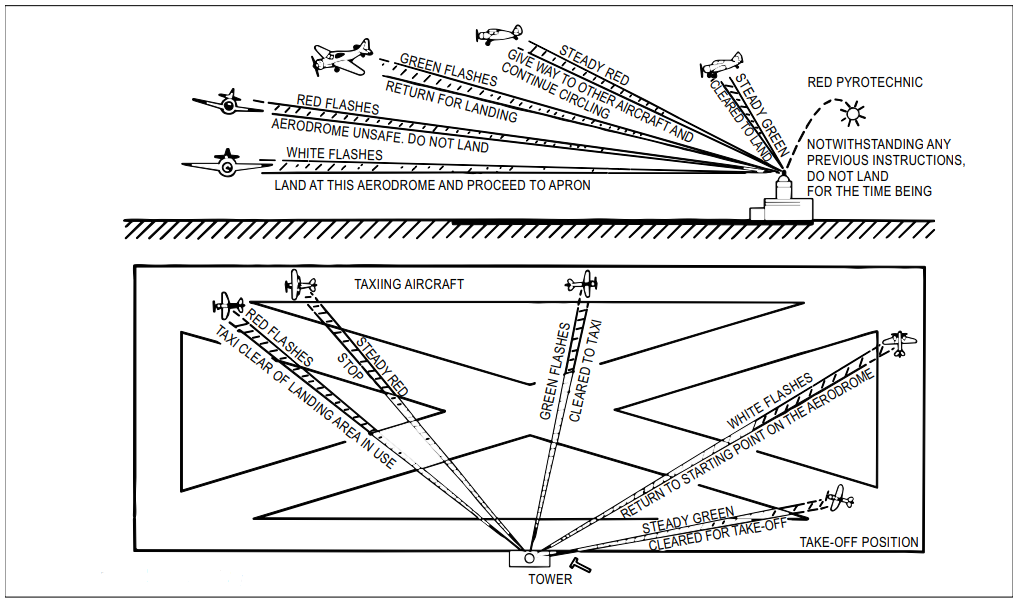
Table AP 1-1
Light | From Aerodrome Control to: | ||
Aircraft in flight | Aircraft on the ground | ||
Directed towards aircraft concerned (see Figure A1-1). | Steady green | Cleared to land | Cleared for take-off |
Steady red | Give way to other aircraft and continue circling | Stop | |
Series of green flashes | Return for landing20 | Cleared to taxi | |
Series of red flashes | Aerodrome unsafe, do not land | Taxi clear of landing area in use | |
Series of white flashes | Land at this aerodrome and proceed to apron21 | Return to starting point on the aerodrome | |
Red pyrotechnic | Notwithstanding any previous instructions, do not land for the time being | ||
Figure A1-1
3.1.2.Acknowledgement by an aircraft
(a)When in flight:
(1)during the hours of daylight:
—by rocking the aircraft’s wings, except for the base and final legs of the approach;
(2)during the hours of darkness:
—by flashing on and off twice the aircraft’s landing lights or, if not so equipped, by switching on and off twice its navigation lights.
(b)When on the ground:
(1)during the hours of daylight:
—by moving the aircraft’s ailerons or rudder;
(2)during the hours of darkness:
—by flashing on and off twice the aircraft’s landing lights or, if not so equipped, by switching on and off twice its navigation lights.
3.1.3.Instructions for ground vehicles or pedestrians
(a)When communications by a system of visual signals is deemed to be adequate, or in the case of radio communication failure, the signals given hereunder shall have the meaning indicated in the table below.
Light signal from aerodrome control | Meaning |
Green flashes | Permission to cross landing area or to move onto taxiway |
Steady red | Stop |
Red flashes | Move off the landing area or taxiway and watch out for aircraft |
White flashes | Vacate manoeuvring area in accordance with local instructions |
(b)In emergency conditions or if the signals in point (a) are not observed, the signal given hereunder shall be used for runways or taxiways equipped with a lighting system and shall have the meaning indicated in the table below.
Light signal from aerodrome control | Meaning |
Flashing runway or taxiway lights | Vacate the runway and observe the tower for light signal |
3.2.Visual ground signals
3.2.1.Prohibition of landing
3.2.1.1. A horizontal red square panel with yellow diagonals (Figure A1-2) when displayed in a signal area indicates that landings are prohibited and that the prohibition is liable to be prolonged.

Figure A1-2
3.2.2.Need for special precautions while approaching or landing
3.2.2.1. A horizontal red square panel with one yellow diagonal (Figure A1-3) when displayed in a signal area indicates that owing to the bad state of the manoeuvring area, or for any other reason, special precautions must be observed in approaching to land or in landing.

Figure A1-3
3.2.3.Use of runways and taxiways
3.2.3.1. A horizontal white dumb-bell (Figure A1-4) when displayed in a signal area indicates that aircraft are required to land, take off and taxi on runways and taxiways only.

Figure A1-4
3.2.3.2. The same horizontal white dumb-bell as in 3.2.3.1 but with a black bar placed perpendicular to the shaft across each circular portion of the dumb-bell (Figure A1-5) when displayed in a signal area indicates that aircraft are required to land and take off on runways only, but other manoeuvres need not be confined to runways and taxiways.

Figure A1-5
3.2.4.Closed runways or taxiways
3.2.4.1.Crosses of a single contrasting colour, white on runways and yellow on taxiways (Figure A1-6), displayed horizontally on runways and taxiways or parts thereof indicate an area unfit for movement of aircraft.

Figure A1-6
3.2.5.Directions for landing or take-off
3.2.5.1. A horizontal white or orange landing T (Figure A1-7) indicates the direction to be used by aircraft for landing and take-off, which shall be in a direction parallel to the shaft of the T towards the cross arm. When used at night, the landing T shall be either illuminated or outlined in white lights.

Figure A1-7
3.2.5.2. A set of two digits (Figure A1-8) displayed vertically at or near the aerodrome control tower indicates to aircraft on the manoeuvring area the direction for take-off, expressed in units of 10 degrees to the nearest 10 degrees of the magnetic compass.

Figure A1-8
3.2.6.Right-hand traffic
3.2.6.1.When displayed in a signal area, or horizontally at the end of the runway or strip in use, a right-hand arrow of conspicuous colour (Figure A1-9) indicates that turns are to be made to the right before landing and after take-off.
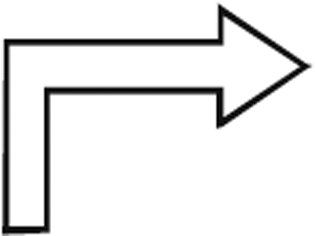
Figure A1-9
3.2.7.Air traffic services reporting office
3.2.7.1.The letter C displayed vertically in black against a yellow background (Figure A1-10) indicates the location of the air traffic services reporting office.

Figure A1-10
3.2.8.Sailplane flights in operation
3.2.8.1. A double white cross displayed horizontally (Figure A1-11) in the signal area indicates that the aerodrome is being used by sailplanes and that sailplane flights are being performed.

Figure A1-11
4.MARSHALLING SIGNALS
4.1.From a signalman/marshaller to an aircraft
4.1.1.The signals for use by the signalman/marshaller, with hands illuminated as necessary to facilitate observation by the pilot, and facing the aircraft in a position shall be:
(a)for fixed-wing aircraft, on left side of aircraft, where best seen by the pilot; and
(b)for helicopters /VTOL-capable aircraft, where the signalman/marshaller can best be seen by the pilot.
4.1.2.Prior to using the following signals, the signalman/marshaller shall ascertain that the area within which an aircraft is to be guided is clear of objects which the aircraft, in complying with SERA.3301(a), might otherwise strike.
| 1. Wingwalker/guide22 Raise right hand above head level with wand pointing up; move left-hand wand pointing down toward body. |
| 2. Identify gate Raise fully extended arms straight above head with wands pointing up. |
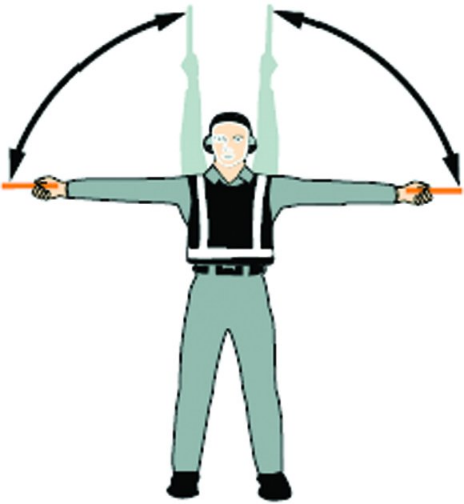
| 3. Proceed to next signalman/marshaller or as directed by tower/ground control Point both arms upward; move and extend arms outward to sides of body and point with wands to direction of next signalman/marshaller or taxi area. |
| 4. Straight ahead Bend extended arms at elbows and move wands up and down from chest height to head. |
| 5(a) Turn left (from pilot’s point of view) With right arm and wand extended at a 90-degree angle to body, make ‘come ahead’ signal with left hand. The rate of signal motion indicates to pilot the rate of aircraft turn. |
| 5(b) Turn right (from pilot’s point of view) With left arm and wand extended at a 90-degree angle to body, make ‘come ahead’ signal with right hand. The rate of signal motion indicates to pilot the rate of aircraft turn. |
| 6(a) Normal stop Fully extend arms and wands at a 90-degree angle to sides and slowly move to above head until wands cross. |
| 6(b) Emergency stop Abruptly extend arms and wands to top of head, crossing wands. |
| 7(a) Set brakes Raise hand just above shoulder height with open palm. Ensuring eye contact with flight crew, close hand into a fist. Do not move until receipt of ‘thumbs up’ acknowledgement from flight crew. |
| 7(b) Release brakes Raise hand just above shoulder height with hand closed in a fist. Ensuring eye contact with flight crew, open palm. Do not move until receipt of ‘thumbs up’ acknowledgement from flight crew. |
| 8(a) Chocks inserted With arms and wands fully extended above head, move wands inward in a ‘jabbing’ motion until wands touch. Ensure acknowledgement is received from flight crew. |
| 8(b) Chocks removed With arms and wands fully extended above head, move wands outward in a ‘jabbing’ motion. Do not remove chocks until authorised by flight crew. |
| 9. Start engine(s) Raise right arm to head level with wand pointing up and start a circular motion with hand; at the same time, with left arm raised above head level, point to engine to be started. |
| 10. Cut engines Extend arm with wand forward of body at shoulder level; move hand and wand to top of left shoulder and draw wand to top of right shoulder in a slicing motion across throat. |
| 11. Slow down Move extended arms downwards in a ‘patting’ gesture, moving wands up and down from waist to knees. |
| 12. Slow down engine(s) on indicated side With arms down and wands toward ground, wave either right or left wand up and down indicating engine(s) on left or right side respectively should be slowed down. |
| 13. Move back With arms in front of body at waist height, rotate arms in a forward motion. To stop rearward movement, use signal 6(a) or 6(b). |
| 14(a) Turns while backing (for tail to starboard) Point left arm with wand down and bring right arm from overhead vertical position to horizontal forward position, repeating right-arm movement. |
| 14(b) Turns while backing (for tail to port) Point right arm with wand down and bring left arm from overhead vertical position to horizontal forward position, repeating left-arm movement. |
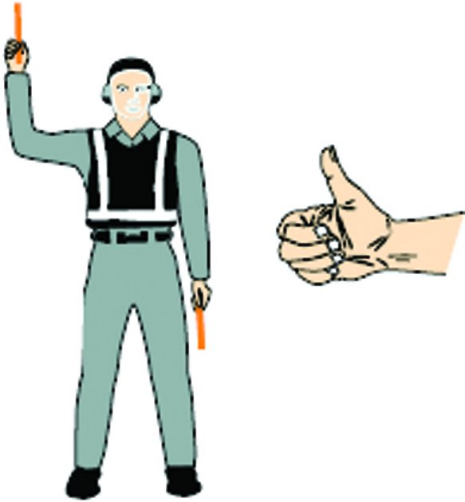
| 15. Affirmative/all clear23 Raise right arm to head level with wand pointing up or display hand with ‘thumbs up’; left arm remains at side by knee. |
| 16. Hover24 Fully extend arms and wands at a 90-degree angle to sides. |
| 17. Move upwards25 Fully extend arms and wands at a 90-degree angle to sides and, with palms turned up, move hands upwards. Speed of movement indicates rate of ascent. |
| 18. Move downwards26 Fully extend arms and wands at a 90-degree angle to sides and, with palms turned down, move hands downwards. Speed of movement indicates rate of descent. |
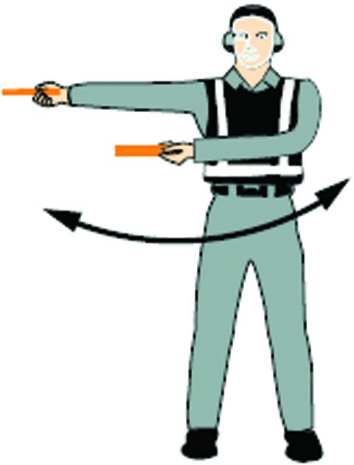
| 19(a) Move horizontally left (from pilot’s point of view)27 Extend arm horizontally at a 90-degree angle to right side of body. Move other arm in same direction in a sweeping motion. |
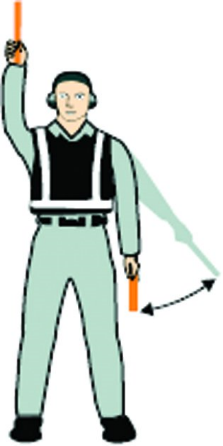


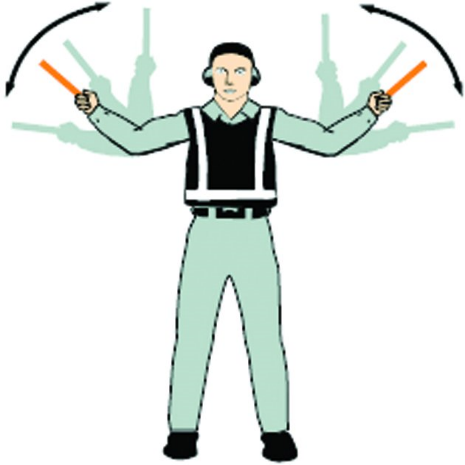








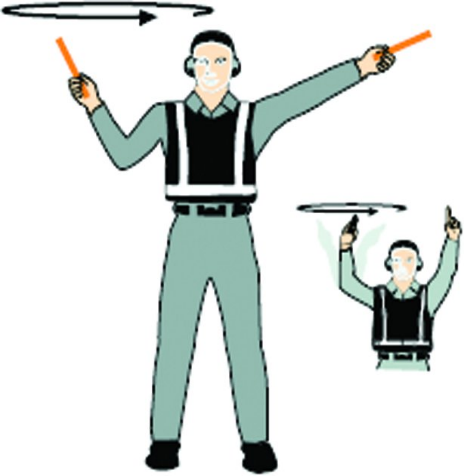
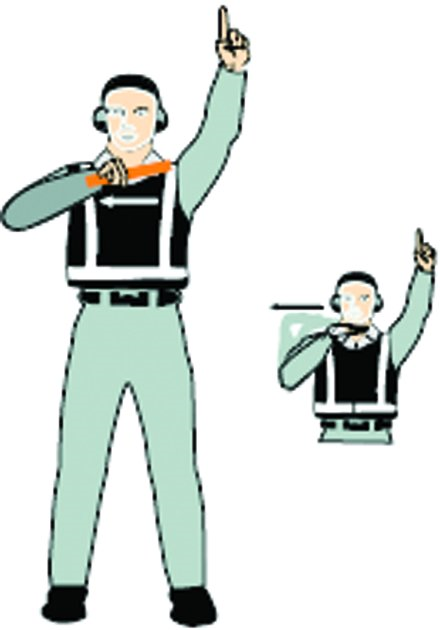

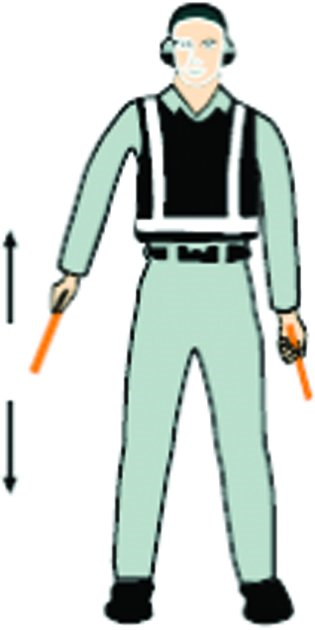


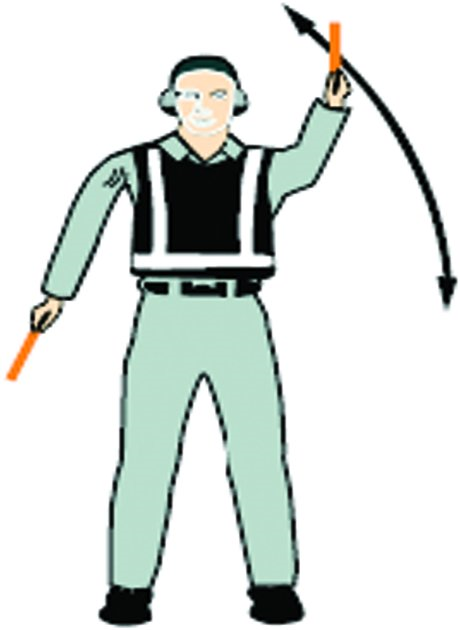


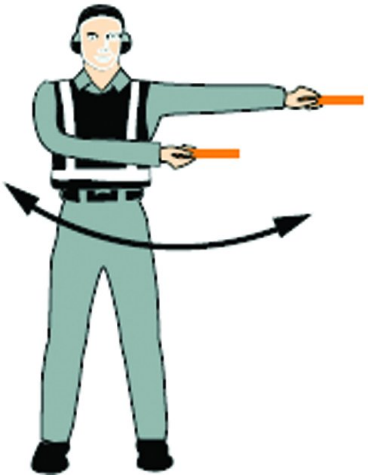
| 19(b) Move horizontally right (from pilot’s point of view)28 Extend arm horizontally at a 90-degree angle to left side of body. Move other arm in same direction in a sweeping motion. |
| 20. Land29 Cross arms with wands downwards and in front of body. |
| 21. Hold position/stand by Fully extend arms and wands downwards at a 45-degree angle to sides. Hold position until aircraft is clear for next manoeuvre. |
| 22. Dispatch aircraft Perform a standard salute with right hand and/or wand to dispatch the aircraft. Maintain eye contact with flight crew until aircraft has begun to taxi. |
| 23. Do not touch controls (technical/servicing communication signal) Extend right arm fully above head and close fist or hold wand in horizontal position; left arm remains at side by knee. |
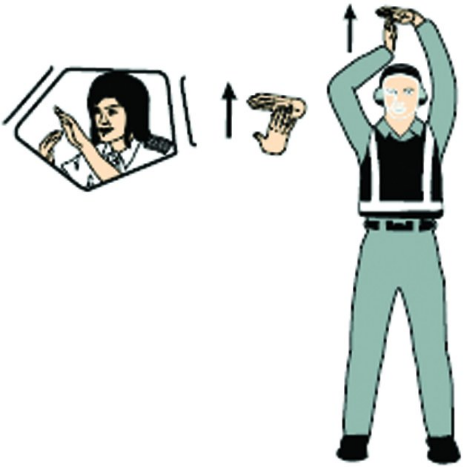
| 24. Connect ground power (technical/servicing communication signal) Hold arms fully extended above head; open left hand horizontally and move finger tips of right hand into and touch open palm of left hand (forming a ‘T’). At night, illuminated wands can also be used to form the ‘T’ above head. |
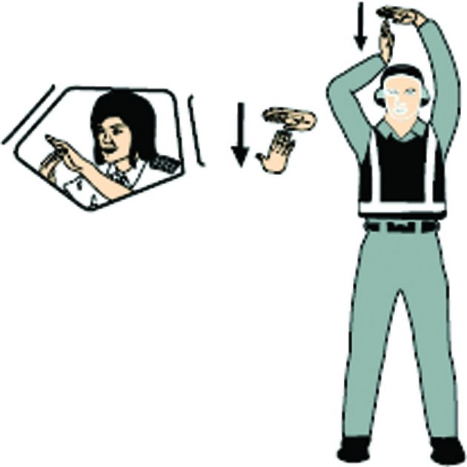
| 25. Disconnect power (technical/servicing communication signal) Hold arms fully extended above head with finger tips of right hand touching open horizontal palm of left hand (forming a ‘T’); then move right hand away from the left. Do not disconnect power until authorised by flight crew. At night, illuminated wands can also be used to form the ‘T’ above head. |
| 26. Negative (technical/servicing communication signal) Hold right arm straight out at 90 degrees from shoulder and point wand down to ground or display hand with ‘thumbs down’; left hand remains at side by knee. |
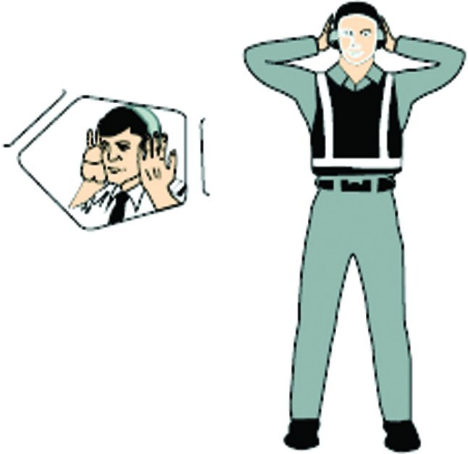
| 27. Establish communication via interphone (technical/servicing communication signal) Extend both arms at 90 degrees from body and move hands to cup both ears. |
| 28. Open/close stairs (technical/servicing communication signal)30 With right arm at side and left arm raised above head at a 45-degree angle, move right arm in a sweeping motion towards top of left shoulder. |






4.2.From the pilot of an aircraft to a signalman/marshaller
4.2.1.These signals shall be used by a pilot in the cockpit with hands plainly visible to the signalman/marshaller, and illuminated as necessary to facilitate observation by the signalman/marshaller.
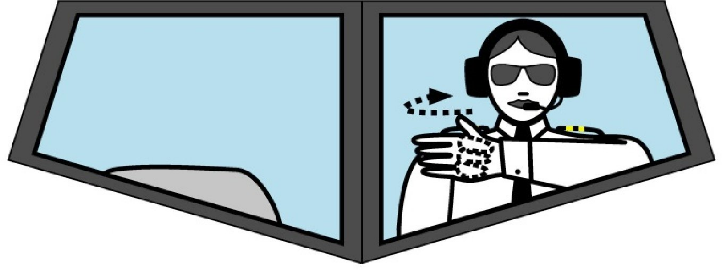
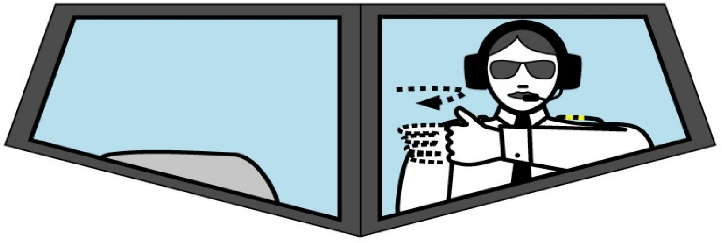
| (a)Brakes engaged: raise arm and hand, with fingers extended, horizontally in front of face, then clench fist. |
| (b)Brakes released: raise arm, with fist clenched, horizontally in front of face, then extend fingers. |
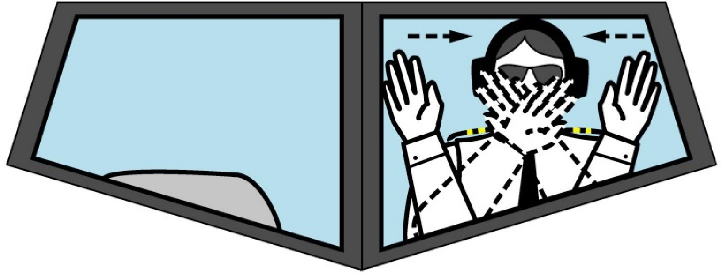
| (c)Insert chocks: arms extended, palms outwards, move hands inwards to cross in front of face. |
| (d)Remove chocks: hands crossed in front of face, palms outwards, move arms outwards. |
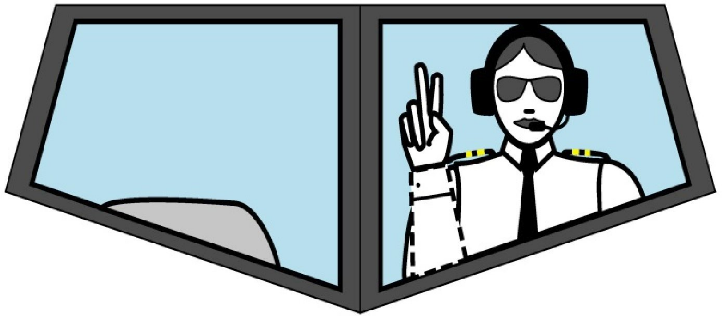
| (e)Ready to start engine(s): Raise the appropriate number of fingers on one hand indicating the number of the engine to be started. |

4.3.Technical/servicing communication signals
4.3.1.Manual signals shall only be used when verbal communication is not possible with respect to technical/servicing communication signals.
4.3.2.Signalmen/marshallers shall ensure that an acknowledgement is received from the flight crew with respect to technical/servicing communication signals.
5.STANDARD EMERGENCY HAND SIGNALS
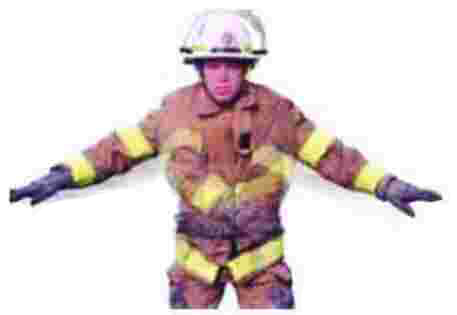
5.1.The following hand signals are established as the minimum required for emergency communication between the ARFF incident commander/ARFF firefighters and the cockpit and/or cabin crews of the incident aircraft. ARFF emergency hand signals should be given from the left front side of the aircraft for the cockpit crew.
| 1. Recommend evacuation Evacuation recommended based on aircraft rescue and fire-fighting and Incident Commander’s assessment of external situation. Arm extended from body, and held horizontal with hand upraised at eye level. Execute beckoning arm motion angled backward. Non-beckoning arm held against body. Night — same with wands. |
| 2. Recommend stop Recommend evacuation in progress be halted. Stop aircraft movement or other activity in progress. Arms in front of head — Crossed at wrists Night — same with wands. |
| 3. Emergency contained No outside evidence of dangerous conditions or ‘all-clear.’ Arms extended outward and down at a 45 degree angle. Arms moved inward below waistline simultaneously until wrists crossed, then extended outward to starting position. Night — same with wands. |
| 4. Fire Move right-hand in a ‘fanning’ motion from shoulder to knee, while at the same time pointing with left hand to area of fire. Night — same with wands. |


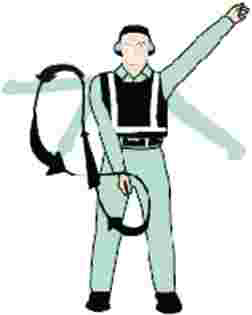
GM1 to Appendix 1(4.1) MARSHALLING SIGNALS
ED Decision 2013/013/R
FROM A SIGNALMAN/MARSHALLER TO AN AIRCRAFT — GENERAL
(a)The meaning of the relevant signals remains the same if bats, illuminated wands or torch lights are held rather than the signalman’s hands being illuminated.
(b)The aircraft engines are numbered, for the signalman facing the aircraft, from right to left (i.e. No 1 engine being the port outer engine).
(c)References to wands may also be read to refer to daylight-fluorescent table-tennis bats or gloves (daytime only).
(d)References to the signalman may also be read to refer to marshaller.
(e)The design of many aircraft is such that the path of the wing tips, engines and other extremities cannot always be monitored visually from the flight deck while the aircraft is being manoeuvred on the ground.
GM1 to Appendix 1(4.2.1.1) MARSHALLING SIGNALS
ED Decision 2013/013/R
FROM THE PILOT OF AN AIRCRAFT TO A SIGNALMAN/MARSHALLER — BRAKES
When providing the signal for ‘brakes engaged’ the moment the fist is clenched indicates the moment of brake engagement. When providing the signal for ‘brakes released’ the moment the fingers are extended indicates the moment of brake release.
GM1 to Appendix 1(5.1) STANDARD EMERGENCY HAND SIGNALS
ED Decision 2013/013/R
GENERAL
In order to communicate more effectively with the cabin crew, emergency hand signals may be given by ARFF firefighters from positions other than those that would be used by a signalman to provide marshalling signals.
Appendix 2 Unmanned free balloons
Regulation (EU) 2024/404
1.CLASSIFICATION OF UNMANNED FREE BALLOONS
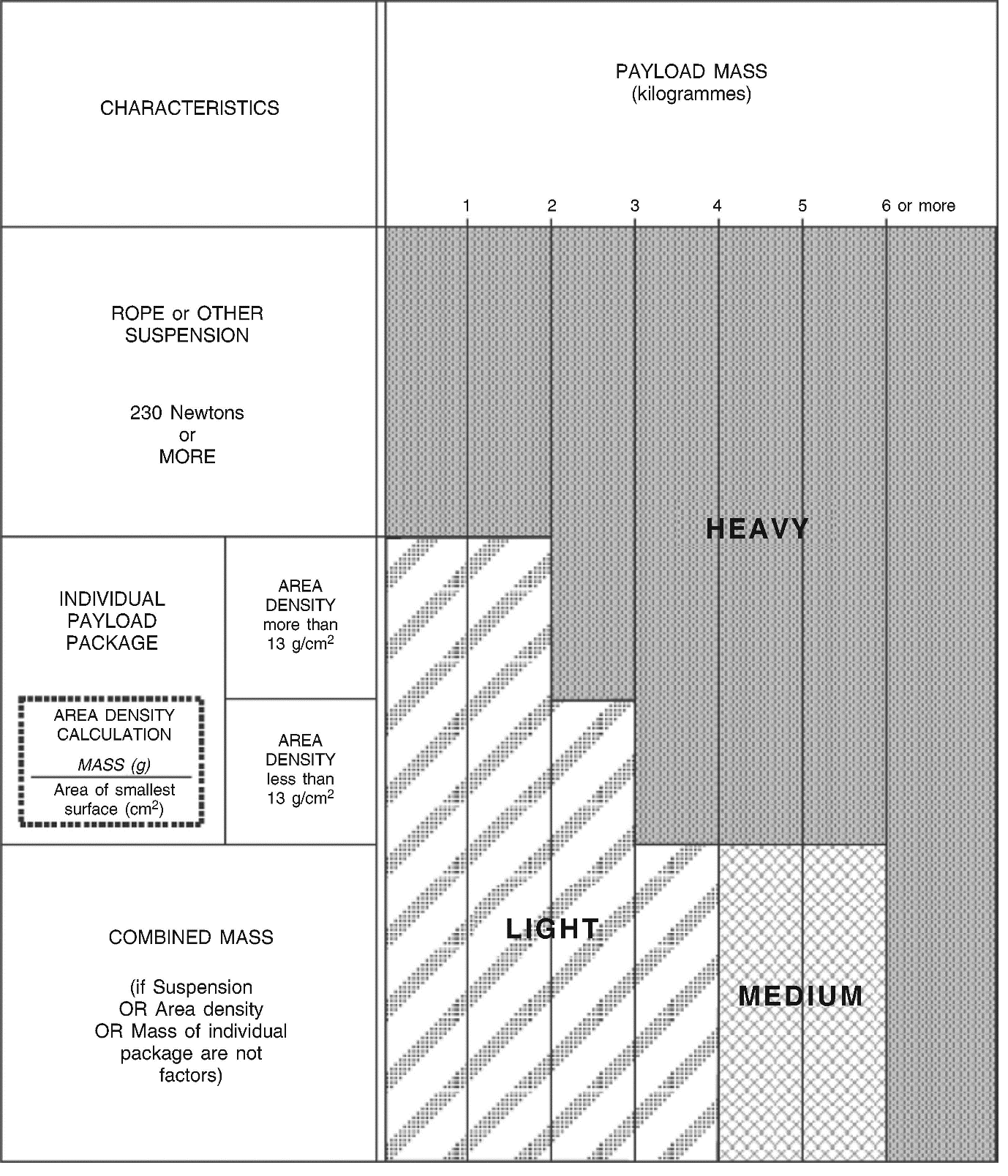
1.1.Unmanned free balloons shall be classified as (see Figure AP2-1):
(a)light: an unmanned free balloon which carries a payload of one or more packages with a combined mass of less than 4 kg, unless qualifying as a heavy balloon in accordance with (c)(2),(3) or (4); or
(b)medium: an unmanned free balloon which carries a payload of two or more packages with a combined mass of 4 kg or more, but less than 6 kg, unless qualifying as a heavy balloon in accordance with (c)(2), (3) or (4) below; or
(c)heavy: an unmanned free balloon which carries a payload which:
(1)has a combined mass of 6 kg or more; or
(2)includes a package of 3 kg or more; or
(3)includes a package of 2 kg or more with an area density of more than 13 g per square centimetre, determined by dividing the total mass in grams of the payload package by the area in square centimetres of its smallest surface; or
(4)uses a rope or other device for suspension of the payload that requires an impact force of 230 N or more to separate the suspended payload from the balloon.
2.GENERAL OPERATING RULES
2.1.An unmanned free balloon shall not be operated without authorisation from the State from which the launch is made.
2.2.An unmanned free balloon, other than a light balloon used exclusively for meteorological purposes and operated in the manner prescribed by the competent authority, shall not be operated across the territory of another State without authorisation from the other State concerned.
2.3.The authorisation referred to in 2.2 shall be obtained prior to the launching of the balloon if there is reasonable expectation, when planning the operation, that the balloon may drift into airspace over the territory of another State. Such authorisation may be obtained for a series of balloon flights or for a particular type of recurring flight, e.g. atmospheric research balloon flights.
2.4.An unmanned free balloon shall be operated in accordance with conditions specified by the State of Registry and the State(s) expected to be overflown.
2.5.An unmanned free balloon shall not be operated in such a manner that impact of the balloon, or any part thereof, including its payload, with the surface of the earth, creates a hazard to persons or property.
2.6.A heavy unmanned free balloon shall not be operated over the high seas without prior coordination with the ANSP(s).
Figure AP2-1
3.OPERATING LIMITATIONS AND EQUIPMENT REQUIREMENTS
3.1.A heavy unmanned free balloon shall not be operated without authorisation from the ANSP(s) at or through any level below 18 000 m (60 000 ft) pressure-altitude at which:
(a)there are clouds or obscuring phenomena of more than four oktas coverage; or
(b)the horizontal visibility is less than 8 km.
3.2.A heavy or medium unmanned free balloon shall not be released in a manner that will cause it to fly lower than 300 m (1 000 ft) over the congested areas of cities, towns or settlements or an open-air assembly of persons not associated with the operation.
3.3.A heavy unmanned free balloon shall not be operated unless:
(a)it is equipped with at least two payload flight-termination devices or systems, whether automatic or operated by telecommand, that operate independently of each other;
(b)for polyethylene zero-pressure balloons, at least two methods, systems, devices, or combinations thereof, that function independently of each other are employed for terminating the flight of the balloon envelope;
(c)the balloon envelope is equipped with either a radar reflective device(s) or radar reflective material that will present an echo to surface radar operating in the 200 MHz to 2 700 MHz frequency range, and/or the balloon is equipped with such other devices as will permit continuous tracking by the operator beyond the range of ground-based radar.
3.4.A heavy unmanned free balloon shall not be operated under the following conditions:
(a)in an area where ground-based SSR equipment is in use, unless it is equipped with a secondary surveillance radar transponder, with pressure-altitude reporting capability, which is continuously operating on an assigned code, or which can be turned on when necessary by the tracking station; or
(b)in an area where ground-based ADS-B equipment is in use, unless it is equipped with an ADS-B transmitter, with pressure-altitude reporting capability, which is continuously operating or which can be turned on when necessary by the tracking station.
3.5.An unmanned free balloon that is equipped with a trailing antenna that requires a force of more than 230 N to break it at any point shall not be operated unless the antenna has coloured pennants or streamers that are attached at not more than 15 m intervals.
3.6.A heavy unmanned free balloon shall not be operated below 18 000 m (60 000 ft) pressure-altitude at night or during any other period prescribed by the competent authority, unless the balloon and its attachments and payload, whether or not they become separated during the operation, are lighted.
3.7.A heavy unmanned free balloon that is equipped with a suspension device (other than a highly conspicuously coloured open parachute) more than 15 m long shall not be operated during night below 18 000 m (60 000 ft) pressure-altitude unless the suspension device is coloured in alternate bands of high conspicuity colours or has coloured pennants attached.
4.TERMINATION
4.1.The operator of a heavy unmanned free balloon shall activate the appropriate termination devices required by 3.3(a) and (b):
(a)when it becomes known that weather conditions are less than those prescribed for the operation;
(b)if a malfunction or any other reason makes further operation hazardous to air traffic or to persons or property on the surface; or
(c)prior to unauthorised entry into the airspace over another State’s territory.
5.FLIGHT NOTIFICATION
5.1.Pre-flight notification
5.1.1.Early notification of the intended flight of an unmanned free balloon in the medium or heavy category shall be made to the appropriate air traffic services unit not less than seven days before the date of the intended flight.
5.1.2.Notification of the intended flight shall include such of the following information as may be required by the appropriate air traffic services unit:
(a)balloon flight identification or project code name;
(b)balloon classification and description;
(c)SSR code, aircraft address or NDB frequency as applicable;
(d)operator’s name and telephone number;
(e)launch site;
(f)estimated time of launch (or time of commencement and completion of multiple launches);
(g)number of balloons to be launched and the scheduled interval between launches (if multiple launches);
(h)expected direction of ascent;
(i)cruising level(s) (pressure-altitude);
(j)the estimated elapsed time to pass 18 000 m (60 000 ft) pressure-altitude or to reach cruising level if at or below 18 000 m (60 000 ft), together with the estimated location. If the operation consists of continuous launchings, the time to be included shall be the estimated time at which the first and the last in the series will reach the appropriate level (e.g. 122136Z–130330Z);
(k)the estimated date and time of termination of the flight and the planned location of the impact/recovery area. In the case of balloons carrying out flights of long duration, as a result of which the date and time of termination of the flight and the location of impact cannot be forecast with accuracy, the term ‘long duration’ shall be used. If there is to be more than one location of impact/recovery, each location shall be listed together with the appropriate estimated time of impact. If there is to be a series of continuous impacts, the time to be included shall be the estimated time of the first and the last in the series (e.g. 070330Z–072300Z).
5.1.3.Any changes in the pre-launch information notified in accordance with point 5.1.2 shall be forwarded to the ATS unit concerned not less than 6 hours before the estimated time of launch, or in the case of solar or cosmic disturbance investigations involving a critical time element, not less than 30 minutes before the estimated time of the commencement of the operation.
5.2.Notification of launch
5.2.1.Immediately after a medium or heavy unmanned free balloon is launched the operator shall notify the appropriate air traffic services unit of the following:
(a)balloon flight identification;
(b)launch site;
(c)actual time of launch;
(d)estimated time at which 18 000 m (60 000 ft) pressure-altitude will be passed, or the estimated time at which the cruising level will be reached if at or below 18 000 m (60 000 ft), and the estimated location; and
(e)any changes to the information previously notified in accordance with 5.1.2(g) and (h).
5.3.Notification of cancellation
5.3.1.The operator shall notify the appropriate air traffic services unit immediately when it is known that the intended flight of a medium or heavy unmanned free balloon, previously notified in accordance with paragraph 5.1, has been cancelled.
6.POSITION RECORDING AND REPORTS
6.1.The operator of a heavy unmanned free balloon operating at or below 18 000 m (60 000 ft) pressure-altitude shall monitor the flight path of the balloon and forward reports of the balloon’s position as requested by air traffic services. Unless air traffic services require reports of the balloon’s position at more frequent intervals, the operator shall record the position every 2 hours.
6.2.The operator of a heavy unmanned free balloon operating above 18 000 m (60 000 ft) pressure-altitude shall monitor the flight progress of the balloon and forward reports of the balloon’s position as requested by air traffic services. Unless air traffic services require reports of the balloon’s position at more frequent intervals, the operator shall record the position every 24 hours.
6.3.If a position cannot be recorded in accordance with 6.1 and 6.2, the operator shall immediately notify the appropriate air traffic services unit. This notification shall include the last recorded position. The appropriate air traffic services unit shall be notified immediately when tracking of the balloon is re-established.
6.4.One hour before the beginning of planned descent of a heavy unmanned free balloon, the operator shall forward to the appropriate ATS unit the following information regarding the balloon:
(a)the current geographical position;
(b)the current level (pressure-altitude);
(c)the forecast time of penetration of 18 000 m (60 000 ft) pressure-altitude, if applicable;
(d)the forecast time and location of ground impact.
6.5.The operator of a heavy or medium unmanned free balloon shall notify the appropriate air traffic services unit when the operation is ended.
GM1 to Appendix 2(3.3b)) OPERATING LIMITATIONS AND EQUIPMENT REQUIREMENTS
ED Decision 2013/013/R
SUPER-PRESSURE BALLOONS
Super-pressure balloons do not require flight termination devices as they quickly rise after payload discharge and burst without the need for a device or system designed to puncture the balloon envelope. In this context a super-pressure balloon is a simple non-extensible envelope capable of withstanding a differential of pressure, higher inside than out. It is inflated so that the smaller night-time pressure of the gas still fully extends the envelope. Such a super-pressure balloon will keep essentially constant level until too much gas diffuses out of it.